
S&P Hits Record as Inflation Moderates
WEEKLY MARKET SUMMARY
Global Equities: Major US stock indexes were mixed over the week, with the S&P 500 setting fresh record highs while the Dow Jones Industrial Average slipped. The S&P 500 closed at a record on Thursday, clearing 7,800 for the first time after touching an intraday high of 7,816.70, and finished the week up 0.4%, its third straight weekly advance and its longest winning streak since late May. The Nasdaq Composite ended just slightly positive at 0.1%, while the Dow fell -0.5%, its first negative week in three. Two subdued inflation reports drove much of the gain, easing concern that the Federal Reserve would need to raise rates again in September. Small caps were bolstered by the soft inflation data and posted another weekly gain, ending 1.2% higher during the week. Foreign stocks were also positive, with Developed International stocks ending the week up 0.1% and emerging markets gaining 1.5%.
Fixed Income: Treasury yields were little changed as inflation data removed some urgency around further Fed tightening. The 10-Year Treasury yield ended near 4.65%, essentially flat over the five sessions, after the Treasury sold new 10-year notes at 4.68%, the highest 10-year auction yield since the global financial crisis. The 2-year note yield, which tracks Fed policy expectations most closely, drifted toward multi-week lows, ending at 4.17%. Futures markets trimmed the odds of a September rate hike to roughly 32% after inflation data provided the Fed with a longer leash to pause on interest rate policy changes.
Commodities: Crude oil rose for the week, gaining roughly 5% as traders monitored stalled diplomatic efforts to reopen the Strait of Hormuz and reports of a fresh tanker attack near the Persian Gulf. West Texas Intermediate traded near $82 per barrel on Friday, while Brent crude hovered around $88.50. The International Energy Agency (IEA) revised its global oil demand forecast lower, projecting a contraction of 1.6 million barrels per day in 2026.
WEEKLY ECONOMIC SUMMARY
Inflation Cools Again: The July Consumer Price Index (CPI) rose 0.1% for the month and 3.4% from a year earlier, down from 3.5% in June and in line with forecasts. Core CPI, which excludes food and energy, increased 0.2% during the month and eased to 2.5% year over year. Shelter accounted for roughly two-thirds of the monthly increase. Both readings remain above the Fed's 2% target, but the tame prints suggest the energy-driven inflation surge earlier in the year is moderating.
Producer Prices Stay Firm: Producer prices told a more mixed story. The July Producer Price Index (PPI) was unchanged during the month, below the 0.1% consensus, but core PPI excluding food, energy and trade services rose 0.4%, up from June’s soft 0.1% increase. On a year-over-year basis, both headline and core producer prices are running at 4.7% inflation. In addition to energy prices, wholesale food costs were also volatile, with lettuce prices collapsing 73% due to the cyclospora outbreak, and egg prices surging 37%.
Consumer Spending Softens: Signs of consumer fatigue emerged in July as retail and food services sales fell 0.6% to $763.6 billion, the largest monthly decline in more than a year. Motor vehicle sales led the drop, falling 1.8%, and online retailers declined 2.2% after a strong June promotional period from Amazon’s Prime Day and competitor sales. Excluding autos and gasoline, sales fell 0.2%. Separately, the University of Michigan's preliminary August consumer sentiment index dropped to 51.0 from 55.2 in July, as households stayed focused on inflation and affordability.
Earnings Update: Second quarter earnings from several AI-related companies were mostly positive, although market reactions were mixed. CoreWeave (CRWV) reported a 112.5% increase in revenue and a $104 billion backlog, sending shares up as much as 18%. Super Micro (SMCI) shares surged 19% after guiding first-quarter revenue to $14.5-15.5 billion, far above consensus $11.8 billion estimates. Cisco (CSCO) and Applied Materials (AMAT) both reported solid quarters, but shares sold off on investor concerns over margins and valuations.
The Week Ahead: Retailer earnings dominate the calendar, with Walmart (WMT), Target (TGT), Home Depot (HD), and Lowe's (LOW) all reporting and offering a fresh read on the health of the consumer. Nvidia's (NVDA) results on August 26 loom as the next major catalyst for the artificial-intelligence trade.
CHART OF THE DAY
The Chart of the Day shows the evolution of the market expectations for a September interest rate hike from the Fed, per CME Group’s Fedwatch tool, which analyzes Fed Funds Futures markets. Following the July FOMC meeting, many investors believed that the hawkish contingent of the Fed would convert enough holdouts to implement a September rate hike, with the odds of a rate increase growing as high as 67% by early August. However, those odds have fallen sharply in recent weeks after data showed the economy is strong but by no means overheating, and energy-driven inflation shocks may be easing. Fed Chair Kevin Warsh will most likely make the case for a wait-and-see approach when he speaks at Jackson Hole on August 28th.
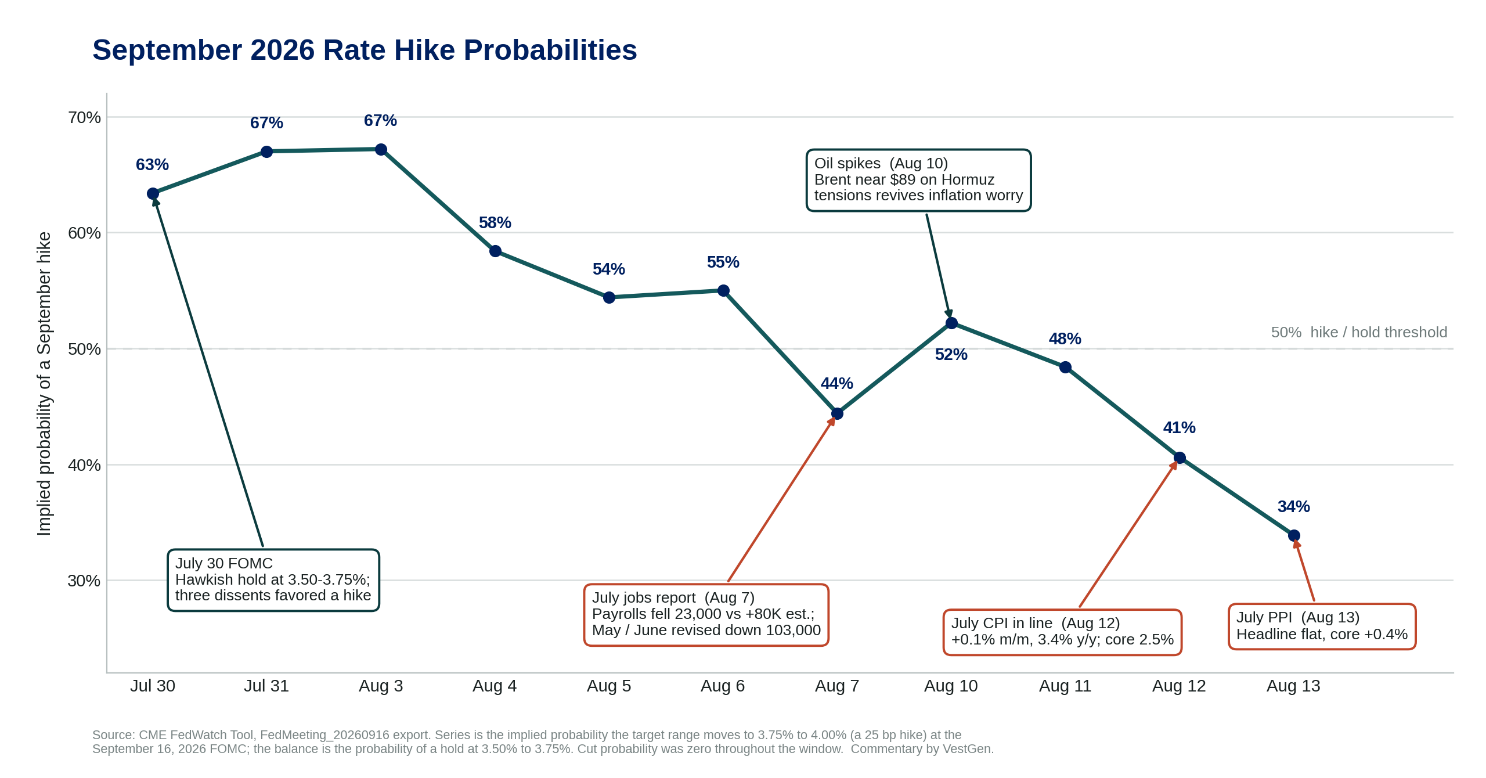
Data Source: CME FedWatch Tool.
Commentary by VestGen Investment Management.
