
Soft Jobs Report Reshapes Rate Expectations
WEEKLY MARKET SUMMARY
Global Equities: US stocks posted a second straight week of gains and their strongest week since April, with the S&P 500 and Nasdaq Composite closing at record highs after a soft July employment report eased fears that the Federal Reserve would need to raise interest rates again this year. The S&P 500 climbed 3.6% and closed above 7,700 for the first time, while the technology-heavy Nasdaq led with a 5.2% advance as chip stocks rebounded. The Dow Jones Industrial Average added 3.0%. Corporate earnings were a tailwind, with roughly 85% of the S&P 500 companies that have reported so far beating analyst expectations. Small caps also gained, with the Russell 2000 rising 3.5%. Developed international stocks advanced 2.8%, aided by a weaker US dollar, while emerging markets ended up 2.4%.
Fixed Income: Treasury yields fell across the curve as the weak jobs report pulled forward the prospect of an eventual policy pivot and reduced the odds of a near-term rate increase. The 10-year note ended around 4.66%, down roughly nine basis points on the week from the multi-year highs reached in late July, while the 2-year note eased to about 4.20%, its lowest level since mid-July. The 30-year bond settled near 5.19%. Futures markets cut the probability of a September rate hike to roughly 42% from about 58% before the report, a notable shift given that three regional Fed presidents had dissented in favor of a hike at the late-July meeting. The pullback in long-end yields offered modest relief to mortgage rates, with the average 30-year fixed sitting around 6.7%.
Commodities: Oil finished lower for the week despite a late bounce, as traders weighed halting progress toward reopening the Strait of Hormuz against renewed flare-ups in the region. West Texas Intermediate settled near $78 a barrel, down more than 7% on the week, while Brent ended around $84. Prices swung sharply, falling early on optimism over an Iran-Oman shipping arrangement, then jumping more than $3 on Thursday after reports that Iran was reviewing a bill to bar US and Israeli vessels from the strait. OPEC+ added to the downward pressure by approving a September production increase of 188,000 barrels a day. Gold climbed to about $4,340 an ounce, a two-month high, as the softer dollar and lower real yields lifted demand for the metal. The 7.2% weekly gain for gold was the largest since January 2026.
WEEKLY ECONOMIC SUMMARY
Jobs Report Surprises to the Downside: The economy unexpectedly shed 23,000 jobs in July, badly missing consensus expectations for a gain of roughly 80,000. The Bureau of Labor Statistics also revised the prior two months lower by a combined 103,000, underscoring a labor market that has cooled faster than expected. The unemployment rate slipped to 4.1% from 4.2%, but the improvement was driven by a decline in the labor force as an estimated 1.4 million people left the workforce in 2026. Average hourly earnings rose 3.2% from a year earlier, below the 3.5% consensus. The report sent stocks higher and yields lower as markets pared back rate-hike expectations.
Manufacturing Gains Momentum: The ISM Manufacturing PMI jumped to 55.6 in July from 53.3 in June, its highest reading since May 2022 and a seventh consecutive month of expansion. New orders, production, and employment all strengthened, with the employment index rising to 52.8 for its first expansionary reading in nearly three years. Price pressures eased slightly, with the prices index at 71.1 versus 73.0, but remained elevated for a 22nd straight month as respondents cited metals costs, tariffs, and higher energy prices.
Services Send a Mixed Signal: The July ISM Services PMI remained in expansionary territory at 54.1, roughly in line with June's 54.0. Beneath the surface, the picture was less reassuring as the services employment index dropped to 47.4, back into contraction and consistent with the softer payroll data, while prices paid surged to 70.3 from 67.7 on higher petroleum costs. The combination of resilient demand, weakening hiring, and sticky input costs highlights the challenge facing the Fed.
The week ahead: Attention turns to inflation, with the July Consumer Price Index and Producer Price Index due next week and likely to shape the debate ahead of the September 16th policy decision. The Cleveland Federal Reserve is forecasting a light headline CPI print of just 0.9%, which would bring inflation down to 3.45% annually. Artificial Intelligence has been driving markets, and several stocks with exposure to AI report during the week, including Supermicro (SMCI), Applied Materials (AMAT), CoreWeave (CRWV), Nebius (NBIS), Cerebras (CBRS), and Cisco (CSCO).
CHART OF THE DAY
The Chart of the Day shows how monthly jobs reports have been initially reported and subsequently revised so far in 2026. Through April, the revisions to the jobs data were a net positive, but that trend has shifted as sharp downward revisions to May and June changed the narrative of a resilient labor market to an anemic one. The health of the jobs market had been driving interest rate hike expectations higher, as it seemed the Fed had only inflation to worry about. With jobs data now looking weak, the employment side of the dual mandate now enters the discussion, which has decreased the odds of a Fed rate hike.
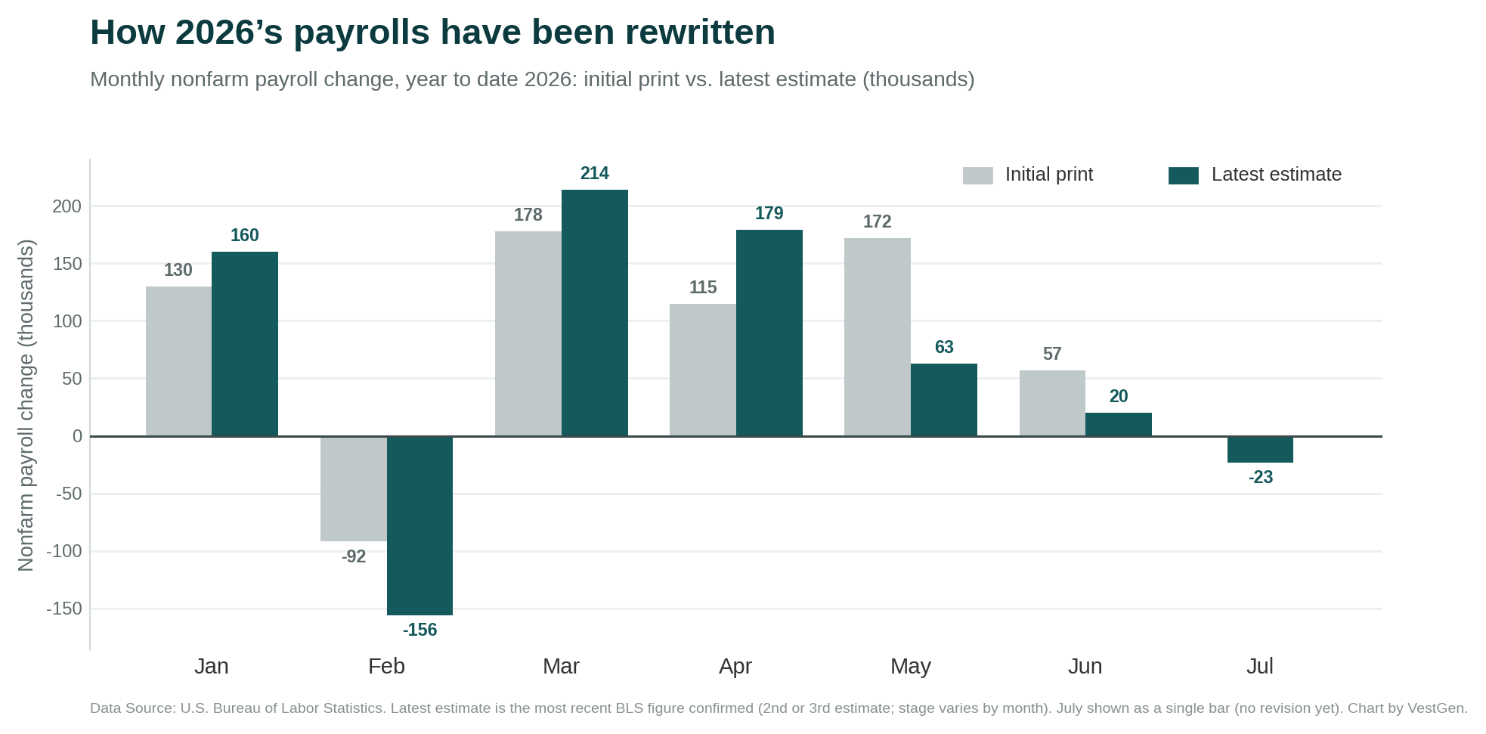
Data Source: U.S. Bureau of Labor Statistics.
Chart and Commentary by VestGen Investment Management.