
Bond Market Turmoil Weighs on Stocks
WEEKLY MARKET SUMMARY
Global Equities: U.S. stocks pulled back from record highs in a choppy week dominated by turmoil in the bond market. The S&P 500 finished the week down -1.4%, the Dow ended -0.8% lower, and the Nasdaq Composite shed -2.1%. Small Cap slipped under pressure from higher long-term interest rates, falling -1.6%. Dollar weakness contributed to relative outperformance from international stocks, with developed foreign markets down -0.4% during the week and emerging markets up 0.8%.
Fixed Income: Long-term Treasury yields surged to their highest levels in nearly two decades, with the 30-year yield climbing to a 19-year high above 5.3% early in the week on concerns over federal deficits and inflation. The stress prompted an intervention on Wednesday from the Treasury Department as Secretary Scott Bessent said it would at least double the size of its liquidity-support buybacks of long-term debt from $2 billion to $4 billion, financed by short-term issuance. Yields fell sharply on the announcement with the 30-year shedding about 10 basis points to 5.18% and the 10-year easing to 4.64%, but the relief proved short-lived. By Thursday the move had reversed, with the 30-year back near 5.25% and the 10-year above 4.70%, above where it traded before the announcement.
Commodities: Crude oil climbed to a near four-week high as geopolitical risk intensified. President Trump vowed an economic campaign against Iran, ordered a freeze in talks, and signaled that a deal was unlikely. In response, Iranian officials floated withdrawing from the Nuclear Non-Proliferation Treaty, while Houthi forces were reported to be preparing further escalation against Saudi Arabia. West Texas Intermediate ended the week around $87 a barrel, while Brent finished above $94. Gold prices were up in response to the weaker dollar and record US deficit, gaining 7% during the week to end at $4,675 per ounce.
WEEKLY ECONOMIC SUMMARY
US Debt Reaches Grim Milestone: The Treasury Department announced Wednesday that the US debt has doubled in less than a decade, reaching $40 trillion. The staggering shortfall is the result of multiple factors, including entitlement spending on the aging population, stimulus measures from the Great Recession and COVID-19 Pandemic, tax cut packages from 2017 and 2025, and growing cost of the war in Iran. The fiscal mismanagement is the driving factor behind rising rates at the long end of the curve, which only compounded the problem. The cost of interest alone on the debt is approximately $1.17 trillion, consuming nearly 19% of federal revenues collected.
A Divided Fed: Minutes from the July 28th-29th FOMC meeting, released Wednesday, revealed an unusually divided committee. Several participants indicated that further policy tightening would likely be necessary if inflation did not decline, and a few who favored raising rates in July argued that acting sooner could forestall a steeper and costlier sequence of increases later. With headline CPI still at 3.4%, the minutes leaned hawkish and kept a September hike in the conversation, even as futures continued to imply only about 35% chance of such a rate increase. Chair Kevin Warsh, who has advocated for a “less is more” approach to data forecasting, raised the possibility of reducing the number of “live” rate decision meetings from eight to six.
Earnings Update: A heavy slate of retailer earnings pointed to a more cautious consumer, with mixed results from big box stores. Home Depot (HD) opened the week Tuesday with a top- and bottom-line beat and reaffirmed its full-year guidance, followed by Lowe's (LOW) on Wednesday. Both home improvement chains cited a difficult housing market. Target (TGT) and Walmart (WMT) earnings got a one-time boost from $994 million and $2.9 billion in tariff refunds, respectively. Target shares rose post-earnings, but Walmart sold off sharply as sales growth disappointed investors. Coming after the first drop in July retail sales in nine months, the results reinforced a picture of a K-shaped economy in which higher-income households keep spending while others pull back.
The Week Ahead: Nvidia (NVDA) reports on August 26th in what has become the single most important print for the artificial-intelligence trade. The Federal Reserve's annual Jackson Hole symposium kicks off on Thursday, where Chair Kevin Warsh delivers his first keynote on Friday, August 28. The July reading of the Fed's preferred inflation gauge, the PCE price index, will be released on Wednesday, August 26.
CHART OF THE DAY
The Chart of the Day shows how federal debt has ballooned over the last 33 years, expanding nearly tenfold to the current $40 trillion shortfall. The US didn’t hit $1 trillion in debt until 1981, but by 1993 that total had quadrupled to over $4 trillion. President Bill Clinton delivered the last balanced budget the country has seen in the late 1990s, and neither party has demonstrated an ounce of fiscal restraint since. The debt-to-GDP ratio has surged to 126%, and the Congressional Budget Office predicts the deficit will swell an additional $10 trillion over the next six years, reaching $50 trillion, if current patterns persist.
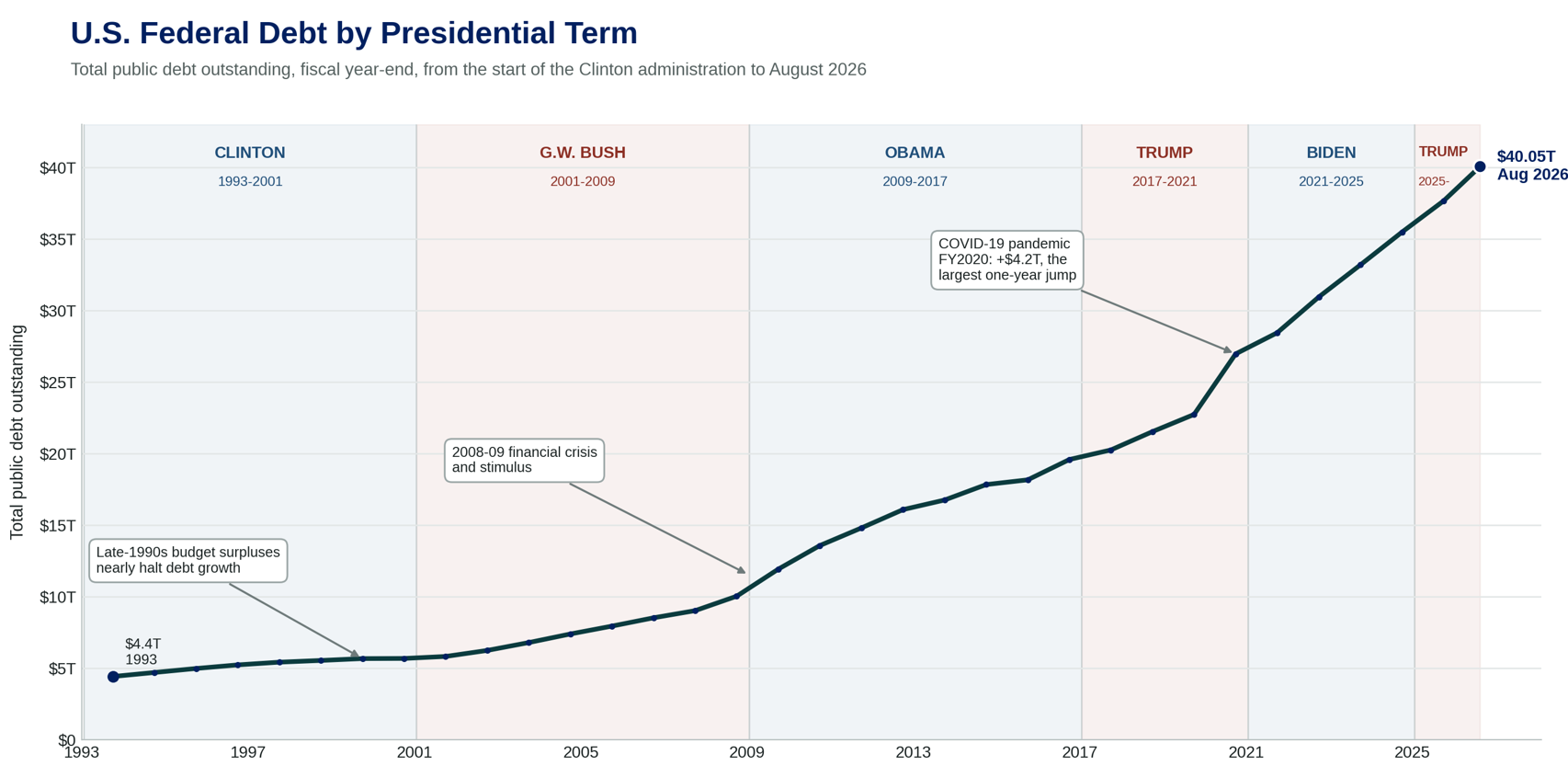
Data Source: US Treasury Department.
Commentary by VestGen Investment Management.
