
WEEKLY MARKET SUMMARY
Global Equities: U.S. stocks rebounded from the prior week's losses, powered by a blockbuster earnings report from Nvidia that reignited the artificial-intelligence trade. Coming off a bond-driven selloff, the major indexes turned higher at midweek, with Thursday marking the best session since early August for the S&P 500, the Nasdaq, and the technology sector. For the week, the S&P 500 finished up 0.5%, the Dow gained 0.6%, and the Nasdaq added 0.9%, leaving all three on track for solid August gains. Small Caps ended the week down -1.5% as a hawkish tone from Fed Chairman Kevin Warsh weighed on investor sentiment for rate-sensitive assets. Foreign Developed market stocks ended the weekly session -0.5%, while Emerging Markets finished flat.
Fixed Income: Fed Chair Kevin Warsh's Jackson Hole keynote struck a hawkish tone, and the bond market moved quickly to price in a greater chance of a September rate increase, with odds shifting swiftly from 35% to 58% following Warsh’s speech. The 2-year note yield, the maturity most sensitive to policy, rose from 4.22% to 4.30% in the minutes around the speech, while the 30-year yield held near 5.3%, close to its highest level since 2007. The 10-year yield had fallen as low as 4.62% earlier in the week but ended the session at 4.73%.
Commodities: Energy prices eased over the week, taking some pressure off the near-term inflation outlook despite reports that Iran struck several oil tankers despite US escorts through the Strait of Hormuz. West Texas Intermediate crude ended the week near $83.50 and Brent traded around $87.40. Gold sold off sharply on Friday as odds of higher rates emerged, falling -3.4% to end the weekly session at $4,507 per ounce.
WEEKLY ECONOMIC SUMMARY
Inflation Stalls Above Target: The Fed's preferred inflation gauge underscored why policymakers remain cautious. The July personal consumption expenditures (PCE) price index rose 0.2% on the month and 3.7% from a year earlier, both slightly hotter than expected and unchanged from June. Core PCE, which strips out food and energy, rose 0.2% on the month and held at 3.3% annually, marking four straight months near that level with little net improvement.
Warsh Turns Hawkish at Jackson Hole: Fed Chairman Kevin Warsh used his first Jackson Hole keynote to sharpen his inflation warning. He said that while recent readings were better than expected, they "do not tell me that underlying trends have meaningfully improved," and he came as close as he has yet to signaling that rates could rise if inflation does not cool. Warsh recommitted to the 2% target as a firm objective, noting that a majority of PCE components have run above 3% over the past year. In keeping with his style, he declined to offer forward guidance and called for a more restrained central bank, one that markets should not look to for their next trade. Overall market reaction was relatively orderly, but the speech triggered an immediate repricing in rate hike odds for the September FOMC.
Earnings Update: The most anticipated earnings report of the season did not disappoint. Nvidia (NVDA) posted fiscal second-quarter revenue of $96.2 billion, up 106% from a year earlier, with data center revenue of $89.0 billion, up 117% and now 92% of the company's sales. Adjusted earnings reached $2.22 per share, more than double the year-ago figure, and gross margins held at 75%. Management guided current-quarter revenue to roughly $108 billion, above the $104 billion consensus, and Chief Executive Jensen Huang forecasts about 70% revenue growth in fiscal 2028, far above the 44% analysts expected. Nvidia also disclosed that Amazon Web Services will buy two million GPUs and said supply commitments have more than doubled to $279 billion. The stock rose 8.7% in response to the strong earnings but gave back roughly half of that on Friday post-Jackson Hole.
The Week Ahead: With a rate hike now the market's base case for September, the incoming inflation and labor data will determine whether the Fed acts. Next week brings the August jobs report and the August consumer price index.
CHART OF THE DAY
The Chart of the Day highlights the Personal Consumption Expenditures (PCE) inflation index, showing both the headline and Core (ex-food and energy) readings. Energy shocks from the Iran war pushed inflation briefly above 4%, but the core reading has also moved slightly higher as prices are up across the board due to both energy inflation and tariff price increases to consumers. Fed Chair Kevin Warsh has floated the idea of using an alternative measure, the Dallas Fed’s Trimmed Mean PCE, which is much lower at 2.3% annually. However, his committee to evaluate a PCE replacement will likely not make a recommendation until year-end. In the meantime, consumers are growing more vocal about the financial stress being caused by rising prices for nearly all goods and services, and the Fed may be forced to capitulate on rate hikes with the Iran war extending past six months.
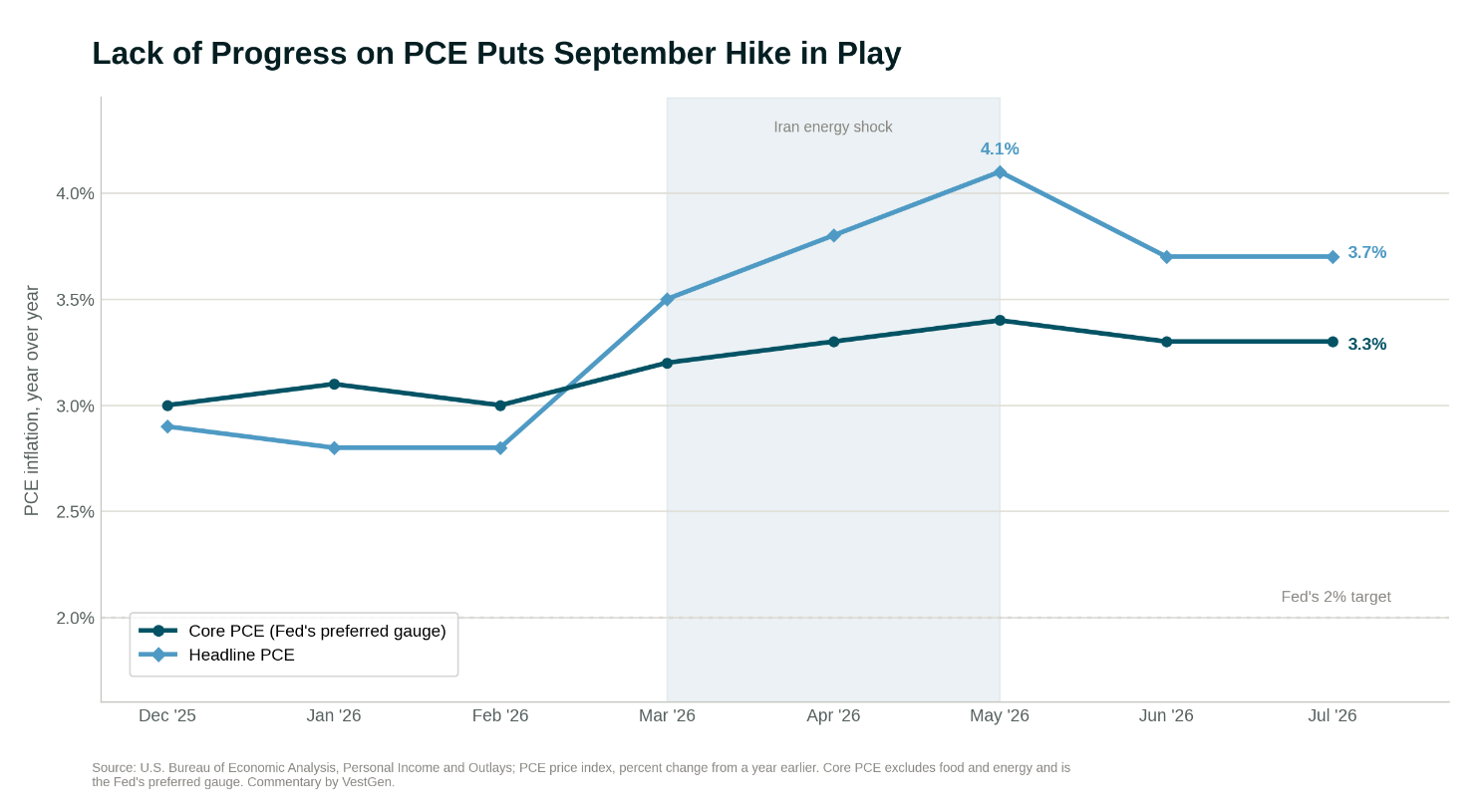
Data Source: US Bureau of Economic Analysis.
Commentary by VestGen Investment Management.
