
Big Tech Reassures Investors on AI
WEEKLY MARKET SUMMARY
Global Equities: Major US stock indexes snapped a two-week losing streak, rebounding as a run of strong mega-cap earnings late in the week eased the concerns over artificial-intelligence spending that had driven July's selloff. Stocks entered the week on the defensive but turned higher after the largest technology companies delivered results. The S&P 500 rose 1.1% and the Nasdaq Composite gained 1.6%, while the Dow Jones Industrial Average added 1%. Even with the weekly gain, all three major indexes finished July lower, reflecting the sharp mid-month decline in AI-linked shares. Small caps underperformed, with the Russell 2000 climbing just 0.1%. Developed international stocks also advanced 2.1%, aided by firm Asian markets, while emerging markets ended up 1.2%.
Fixed Income: Treasury yields pushed to multi-year highs on expectations that the Fed will be forced to hike interest rates in September. The 10-year note reached 4.74% in intraday trading on Friday, its highest level since January 2025, while the 30-year bond hovered near 5.22%, a level last seen in 2007. The 2-year note held around 4.2%. The Federal Reserve left its policy rate unchanged at 3.50% to 3.75% on Wednesday, its fifth consecutive hold, but the decision drew three dissents in favor of a rate increase, reinforcing the view that policy will stay restrictive. Higher rates at the long end of the curve pushed mortgage costs higher, with the average 30-Year Fixed Rate nearing 6.8% as of Friday.
Commodities: Oil steadied at the end of a volatile week but remained sharply higher for the month as the US-Iran conflict continued to threaten supply. West Texas Intermediate held near $84 a barrel after swinging in a range of more than $8 during the week, while Brent settled around $89. Prices whipsawed on Middle East headlines, including a reported Iranian strike on a US base in Jordan and a retaliatory wave of US strikes. Gold climbed above $4,100 an ounce early in the week as the conflict kept safe-haven demand elevated before settling near $4,090, with gains capped by rising real yields.
WEEKLY ECONOMIC SUMMARY
Fed Holds as Dissent Grows: The Federal Open Market Committee left the federal funds rate unchanged at 3.50% to 3.75%, its fifth straight hold, in a 9 to 3 vote. The three dissenters, regional presidents Beth Hammack, Neel Kashkari, and Lorie Logan, each preferred a quarter-point increase to address inflation that has run above the 2% target for more than five years. It was the first time since 2016 that three policymakers dissented in favor of the same direction. The meeting was the second led by Chair Kevin Warsh, whose post-decision statement was again notably brief and continued to omit forward guidance. The Committee described economic activity as expanding at a solid pace despite elevated uncertainty tied in part to the conflict in the Middle East. The next decision is due September 16, with Chair Warsh scheduled to speak at the Jackson Hole symposium in August.
Growth Slows, Inflation Cools: The advance estimate showed the economy grew at a 1.5% annual rate in the second quarter, below the 2.1% consensus and down from 2.1% in the first quarter. The miss traced largely to a wider trade deficit linked to AI-infrastructure imports and a decline in government spending, while consumer spending and business investment both strengthened. The weak GDP print news was offset by a cool inflation report. The June Personal Consumption Expenditures (PCE) price index, the Fed's preferred gauge, fell -0.1% on the month and eased to 3.7% from 4.1% a year earlier, its first monthly decline since 2020, driven by lower energy prices following June's US-Iran ceasefire. Core PCE rose 0.1% on the month and slipped to 3.3% year over year. The personal saving rate fell to 2.7%, a near four-year low, as spending outpaced income growth.
Big Tech Earnings Split the Market: The busiest week of second-quarter earnings drew a sharp divide between companies rewarded for AI investment and those punished for it. Microsoft (MSFT) rose about 15% after strong cloud results, and Amazon (AMZN) gained about 13% on its fastest revenue growth in more than four years and accelerating cloud demand. Meta (META) fell about -8% as rising capital spending and margin concerns overshadowed solid advertising growth, and Apple (AAPL) declined roughly -8% as supply constraints weighed on results. Together the four hyperscalers now guide to combined 2026 capital spending in the range of $720-$745 billion. The reaction marked a shift from the prior week, when Alphabet (GOOG) and Tesla (TSLA) were dumped by investors concerned over capex spending.
The week ahead: Attention turns to the July employment report, due Friday, August 7, for a fresh read on the labor market after June's soft 57,000 gain. The ISM manufacturing and services surveys, along with a lighter slate of second-quarter earnings, round out the calendar. On trade, the administration's reciprocal tariffs are scheduled to take effect August 1, and any late agreements or legal challenges could drive volatility.
CHART OF THE DAY
The Chart of the Day examines how investor concerns over government spending and inflation are pushing rates higher on the long end of the yield curve, despite the Fed’s decision to hold rates steady. The interest rate on a 10-year Treasury bond is really two things added together. The first component is investors’ expectations for the Federal Reserve's short-term rate, on average, over the next ten years. The second is a cushion, called the term premium, which is the extra return investors want for tying up their money for a full decade. For most of the past decade that cushion was thin or even negative, as buyers were happy to hold long bonds for almost no extra reward. That is no longer the case, however, as inflation, government spending, and geopolitical risks have risen. In the chart, the dashed line showing expected Fed policy has stayed relatively steady, yet the 10-year yield has pushed higher and the term premium (the shaded gap between them) has noticeably widened. In plain terms, the recent climb in long-term borrowing costs is not mainly about expecting more rate hikes. It is investors demanding to be paid more to hold long-dated debt due to diminished faith in the fiscal management of the US government. Long-term rates, which influence everything from mortgages to the government's interest bill, may stay elevated even if the Fed holds steady through year end or eventually begins to cut.
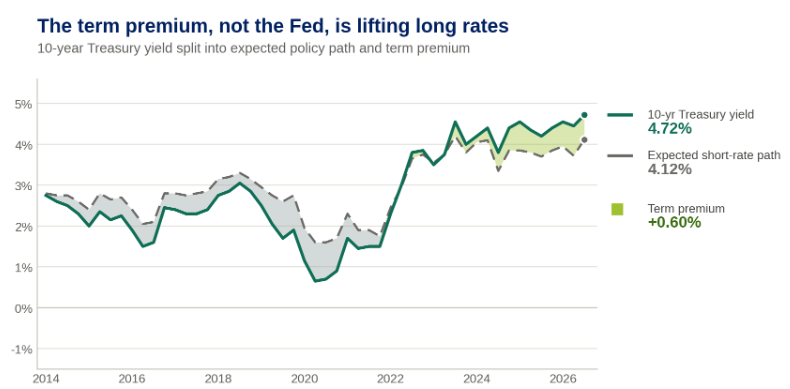
Data Source: St. Louis Federal Reserve.
Chart and Commentary by VestGen Investment Management.