
AI Spending Concerns Pressure Technology Shares
WEEKLY MARKET SUMMARY
Global Equities: All three major U.S. stock indexes posted a second straight losing week as a selloff in the largest technology stocks overwhelmed an otherwise strong start to earnings season. The Nasdaq Composite led the retreat with a -2.1% drop, while the S&P 500 slipped -0.6% and the Dow Jones Industrial Average eased -0.4%. Small caps were not spared from the selling, as the Russell 2000 slipped -1.1%. Developed international stocks were able to cling to a slight weekly gain and ended 0.1% higher as the ECB held rates unchanged. Emerging markets were pressured by the same tech weakness and a fresh round of U.S. tariffs but were also able to finish the week with a slight 0.1% gain.
Fixed Income: Treasury yields climbed for most of the week, with the 10-year note reaching its highest level since January 2025 as surging oil prices revived inflation concerns, before easing on Friday as crude retreated. The 10-year yield topped 4.7% at midweek and finished just below that level, while the 2-year ended near 4.33%. The move reflected a growing conviction that the Federal Reserve will keep policy tight. With headline inflation still well above target and energy costs rising, futures markets raised the odds of a September rate increase to 82%. Traders also priced the likelihood of a July 29th hike at 34%.
Commodities: Oil rallied for most of the week before pulling back on Friday, but still finished higher, as intensifying conflict in the Middle East threatened supply. Brent crude surged past $100 a barrel on Thursday, its highest level since before last month's tentative US-Iran peace deal, following reported Houthi attacks on tankers off Saudi Arabia's Red Sea coast and renewed US threats against Iran. Prices then fell almost -4% on Friday, with Brent settling near $96.80 and West Texas Intermediate around $90 a barrel, after reports of possible fresh US-Iran negotiations. Gold bounced early in the week as the spiraling cost of the Iran war and the Pentagon’s request for an additional an additional $87 billion raised deficit concerns but eased on Friday to close at $4,056 an ounce.
WEEKLY ECONOMIC SUMMARY
New Tariffs Take Effect: The White House pressed ahead with a fresh wave of import duties just as a temporary 10% tariff expired at midnight Friday. The US Trade Representative imposed additional tariffs of 10% or 12.5% on goods from 60 economies under Section 301 of the Trade Act of 1974, citing their failure to bar imports made with forced labor, after the Supreme Court struck down the administration's earlier emergency-powers tariffs in February. Certain products, including some energy imports and goods unavailable from domestic sources, were exempted, and a separate 25% levy on Brazilian goods took effect earlier in the week. Multiple small businesses sued the Trump administration over the weekend, although the new statute may hold up better in court than the previous tariffs, which were struck down by the Supreme Court.
Iran War Escalation: The US-Iran war intensified through the week after the early-July ceasefire collapsed. A US bombing campaign against Iran ran for 13 consecutive nights, aimed at degrading Tehran's ability to threaten maritime traffic, while Iran launched retaliatory drone strikes on US targets in the Gulf and President Trump said he was close to deciding whether to launch "a massive attack." At sea, the US military said it disabled a tanker that tried to bypass its blockade on Iranian ports, and Saudi Arabia struck Yemen's Iran-backed Houthis after the group attacked another Saudi vessel in the Red Sea. The tone softened on Friday as Trump said that Washington and Tehran remain in talks and that Iran seems to be getting "more serious," though he cautioned that the military could still escalate.
Earnings Season Picks Up: Second-quarter results continued to run well ahead of expectations even as the market punished the heaviest AI spenders. With about 27% of S&P 500 companies reported, 86% had beaten earnings estimates and 80% had topped revenue forecasts, according to FactSet, lifting the blended earnings-growth rate to 37.9% year over year from the 23.2% expected at the end of June and putting the quarter on track for the fastest growth since the third quarter of 2021. Nine of the eleven sectors saw higher profit expectations than a month earlier. Mega cap stocks may be in for a rough earnings season, however, as the Magnificent Seven shed roughly $797 billion in market value in a single session on Thursday after Alphabet (GOOG/GOOGL) and Tesla (TSLA) reported results Wednesday evening. Both companies beat on revenue but paired negative free cash flow with sharply higher capital-spending plans. Alphabet lifted its 2026 capital-expenditure guidance to as much as $205 billion, up from a prior range of $180 to $190 billion, while Tesla's capital spending jumped 142% as adjusted earnings badly missed. Tesla fell about -13% on Thursday and Alphabet roughly -7% and pulled down shares of other capex-intensive hyperscalers.
The week ahead: A full calendar awaits with the Fed's Wednesday decision headlining a run of data that includes the advance estimate of second-quarter GDP, the June PCE price index (the Fed's preferred inflation gauge), and the July employment report. It will also be arguably the biggest week for earnings news with Microsoft (MSFT), Meta (META), and Amazon (AMZN) reporting earnings and providing a fresh test of investor patience with rising capital budgets. Rate decisions in Canada and Japan round out the global agenda.
CHART OF THE DAY
The Chart of the Day shows the catalyst for the negative market reaction to otherwise strong big tech earnings this week. When Alphabet (GOOG/GOOGL) and Tesla (TSLA) reported on Wednesday evening, investors focused not on the top-line results but on free cash flow swinging sharply negative as capital spending accelerates. Q2 2026 was Alphabet’s first negative quarterly free cash flow since going public, as second-quarter capital expenditures doubled from a year earlier and management raised its 2026 spending guidance to as much as $205 billion. Tesla's free cash flow turned negative as well, with capital spending up 142%. Shares fell about 7% and 13%, respectively, and helped drag the Magnificent Seven to their worst session since April 2025. For investors, revenue growth alone is no longer enough when it is funded by ever-rising budgets and shrinking cash flow.
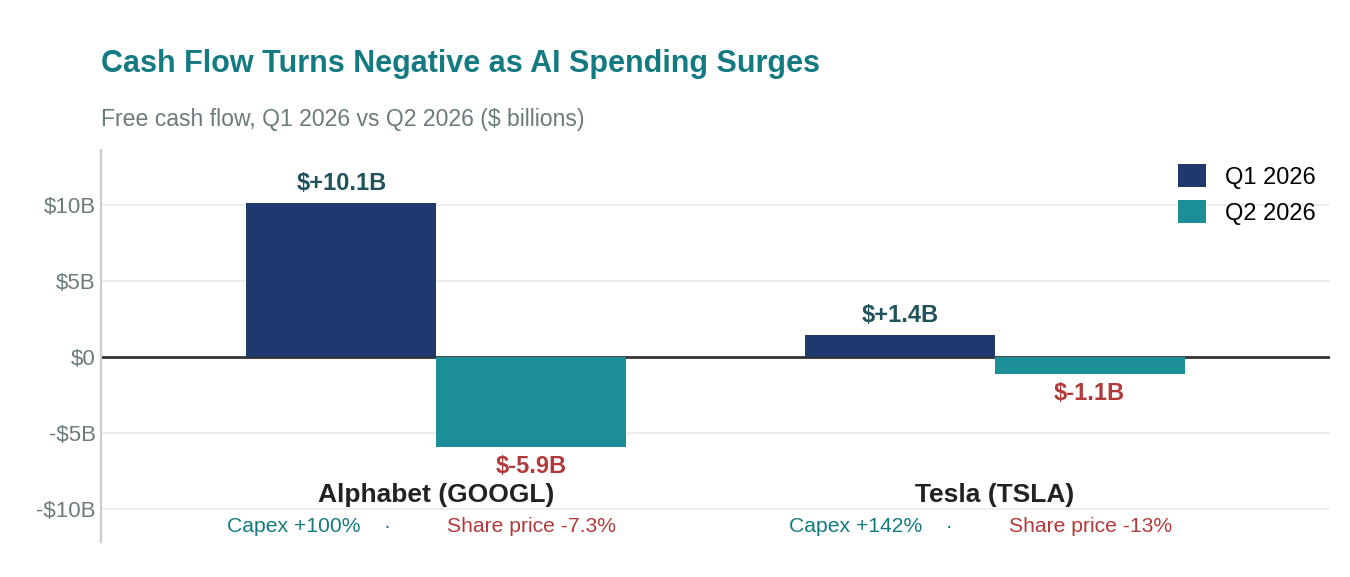
Data Sources: S&P Global Market Intelligence, Alphabet and Tesla earnings calls.
Chart and Commentary by VestGen Investment Management.