WEEKLY MARKET SUMMARY
Global Equities: Investor sentiment on AI continued to sour as heavy capex spending was the focal point of big tech earnings. Stocks rose early in the week but sold off sharply on Friday’s tech rout to send the Nasdaq down -2.9% and the S&P 500 down -1.8%, each its worst day since June 5. For the week, the S&P 500 fell -0.6%, the Nasdaq dropped -2.0%, and the Dow slipped -0.8%. For the S&P 500 and Nasdaq, it was the third straight weekly loss, their longest losing streak since March. Small caps were strong outperformers, with the Russell 2000 gaining 1.3%. The week highlighted the recent rotational trade in which investors have dumped tech in favor of more defensive sectors during October. The Nasdaq fell -5.3% for the month, its worst month since March 2025, while Energy sector stocks rose 13.9%, with Utilities and Consumer Staples both up more than 10%. Overseas, European stocks outperformed, with the STOXX Europe 600 rising 1.7% in local currency terms, and Japan's Nikkei 225 gained about 1.0%. Developed Market stocks outperformed their domestic peers, gaining 0.7% during the week, while Emerging Markets slipped -1.6% on their relatively heavy semiconductor and memory exposure.
Fixed Income: Treasuries rallied as the tech selloff sent investors toward safer assets. The 10-year yield ended the week at 4.94%, down 6 basis points from 5.00% a week earlier and near its lowest level in seven weeks, leaving it 35 basis points lower for October. As expected, the Fed held its benchmark rate at 3.75%-4.00% on Wednesday, but the 10-2 vote revealed a hawkish split, as Governor Lisa Cook and Cleveland Fed President Beth Hammack both dissented in favor of a quarter-point hike. It was Cook's first dissent. The statement upgraded the Fed's view of growth to expanding at a strong pace from solid, repeated that inflation remains elevated, and added that more information will help the Committee set policy. Chair Kevin Warsh said politics played no role in the decision ahead of next week's midterm elections, and announced that starting next year one of the Fed's eight annual meetings will focus solely on broad policy strategy, with no rate decision. Futures continue to price a likely hike at the December 8-9 meeting.
Commodities: Oil extended its rally as attacks on Gulf energy infrastructure continued, including renewed Houthi missile and drone strikes reported on Saudi Aramco's Ras Tanura and Rabigh refineries and the Abqaiq processing facility. WTI briefly dipped below $100 on Tuesday before buyers returned, and finished the week at around $103, while Brent Crude held above $113. Precious metals extended their slide, as the tech rout and expectations of further Fed tightening weighed on prices. Spot gold fell about 3% for the week to roughly $3,875 per ounce, its lowest level since October 2025, and lost about 7% in October for a second straight monthly decline. Silver fell about 9% to near $49. Gold is now down roughly 31% from its January record.
WEEKLY ECONOMIC SUMMARY
Growth Beats: Real GDP grew at a 3.4% annualized rate in the third quarter, ahead of the 3.1% forecast and up from 2.2% in the second quarter, according to the BEA's advance estimate. Investment, consumer spending, and government spending drove the gain, with consumer spending rising 3.8%, matching the prior quarter's pace. AI-related spending was again a major driver, as investment in computers, other information processing equipment, and software added 1.09 percentage points, or about a third of the quarter’s growth. However, much of that hardware is imported, and a jump in imports subtracted 2.64 points from growth, so AI’s net boost to domestic output was considerably smaller than the headline contribution suggests.
PCE Inflation: The Personal Consumption Expenditures (PCE) price index rose 0.5% in September, its largest monthly gain since March, lifting the annual rate to 3.6% from 3.4% in August. Core PCE rose 0.3% for the month and 3.1% from a year ago, in line with expectations, while personal spending rose 0.5%. Strong growth paired with sticky inflation keeps pressure on the Fed heading into December.
Earnings Update: Big Tech results renewed questions about the return on AI spending. Alphabet (GOOGL) reported cloud revenue up 103% to $30.7 billion but missed on revenue and earnings and posted negative free cash flow of $9.07 billion, far worse than the roughly $2.7 billion outflow analysts expected. The company held its 2026 capex guidance at $195 billion to $205 billion and said spending will rise significantly in 2027. Shares fell about -13% on Thursday, the stock's worst day since its 2004 IPO, erasing roughly $500 billion in market value. Microsoft (MSFT) beat estimates on 48% Azure growth, while capex of $45.2 billion including finance leases came in below forecasts as chip supply delays pushed out some capacity. Microsoft also trimmed its capex forecast for the year to $170 billion from $175 billion, and shares were roughly flat on Thursday. Amazon (AMZN) missed on revenue and earnings and issued light fourth quarter guidance, even as AWS growth accelerated to 39%, its fastest pace in nearly five years, and quarterly capex reached $77.3 billion. Intel (INTC) beat third quarter estimates but guided fourth quarter revenue to $15 billion to $16 billion, below the $17 billion expected, as a memory chip shortage weighs on the PC market. Shares plunged about -29% on Friday, their worst day since 1974, capping a roughly -45% October. Outside of tech, Eli Lilly (LLY) rose about 4% on Thursday after revenue surged 39% on demand for its obesity drugs and it raised guidance, while ExxonMobil (XOM) and Chevron (CVX) rose on Friday after topping third quarter forecasts.
The Week Ahead: Tuesday's midterm elections headline a packed week. Apple (AAPL) and Palantir (PLTR) report Monday after the close, with Apple's results its first under CEO John Ternus, followed by AMD (AMD) on Tuesday and Qualcomm (QCOM), Arm (ARM), and Uber (UBER) on Wednesday. On the economic front, the ISM manufacturing index is due Monday and the services index on Wednesday. The week closes with Friday's October jobs report, where economists expect payrolls to rise about 55,000 with the unemployment rate holding at 4.2%.
CHART OF THE DAY
The Chart of the Day looks at the sharp sector rotation underneath a flat-to-lower market in October. The S&P 500 slipped -0.9% for the month, but that headline hides how widely gains spread. Nine of the 11 sectors rose, and seven gained more than 5%. The losses were concentrated in the two sectors most tied to the AI trade. Communication services fell -10.0% and technology -8.3%, and both suffered drawdowns of more than 11% during the month as Alphabet, Meta and the chipmakers sold off. Because those two sectors make up such a large share of the S&P 500, their decline was enough to pull the index lower even though most stocks rose. Investors are shifting sector exposure rather than exiting stocks altogether in favor of bonds, which can be viewed as positive for the overall health of equity markets.
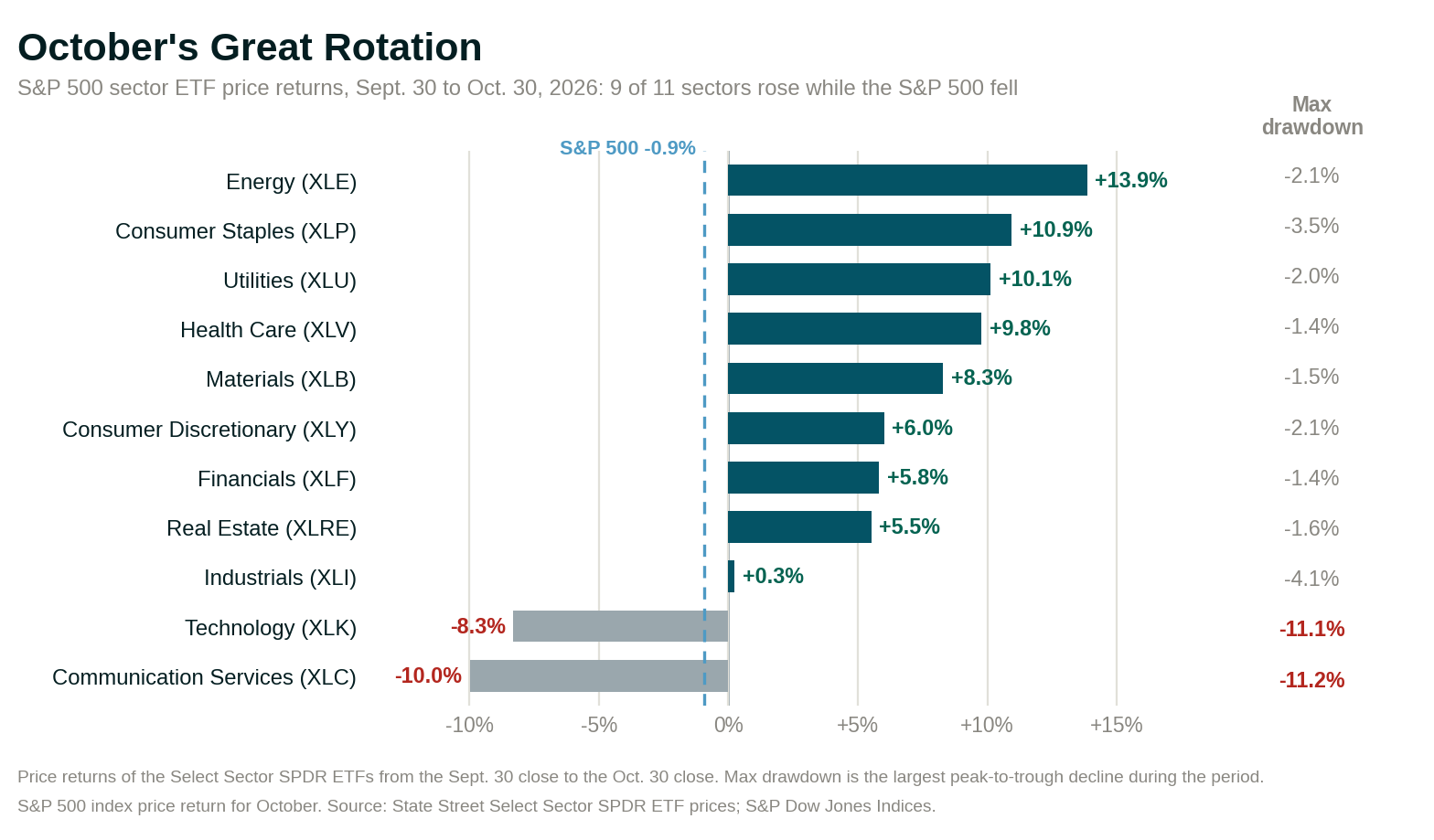
Chart and commentary by VestGen Investment Management.