WEEKLY MARKET SUMMARY
Global Equities: Technology stocks sold off on Thursday as the PHLX Semiconductor Index plunged -6.7%, its biggest one-day decline since June 23. The semiconductor index is now down more than -26% from its June 22 record, though it remains up 51.5% for the year. The selloff was narrow, however, as investors rotated out of tech and into other sectors. On Thursday, roughly two thirds of S&P 500 stocks rose even as the index fell -1.2%. For the week, the S&P 500 slipped -0.5% and the Nasdaq fell -0.7%, its second straight weekly loss, while the Dow rose 0.4% for a third straight weekly gain. Small caps led, with the Russell 2000 up 2.0%. Breadth faded on Friday, however, as decliners outnumbered advancers by nearly two to one on the NYSE. Overseas markets were negative during the week, with developed market stocks ending the session -0.9% lower and emerging markets down -1.3%.
Fixed Income: Treasuries rallied as the tech selloff drove demand for safer assets. Demand for long-dated debt remained a concern early in the week, as Wednesday's $13 billion 20-year bond reopening cleared at a high yield of 5.469%, up from 5.420% at September's sale, with the 10-year yield near 5.11% that day. The picture changed on Thursday, as AI fears drove demand for the relative safety of bonds. With Fed officials in their pre-meeting blackout, futures pricing for a rate hike at next week's meeting fell to under 10%, while odds of a December hike remain at nearly 80%.
Commodities: Oil prices climbed to their highest level in nearly six months as attacks on Saudi Arabia intensified. Brent rose 3.1% on Friday to settle at $116.72 per barrel, its highest close since April 29, after Iran-backed Houthi militants claimed attacks on the Saudi Red Sea port of Yanbu, as well as deadly strikes on an oil field and airport in the kingdom, and UAE authorities reported an oil spill. Traders are also increasingly pricing in the possibility that the US resumes strikes on Iran shortly after midterm elections. US West Texas Intermediate rose 3.8% to $103.27. For the week, Brent gained 6.2%, its third straight weekly advance, while WTI gained about 2%. Brent is now up more than 85% this year. Precious metals moved the other way, as gold fell about 4% for the week and briefly traded below $4,000 per ounce for the first time since July.
WEEKLY ECONOMIC SUMMARY
Housing Slump Deepens: Housing starts fell -5.2% in September to a seasonally adjusted annual rate of 1.221 million units, well below the 1.305 million forecast and the third straight monthly decline. Starts are down -7.4% from a year ago. Single-family starts fell -4.6% to 859,000, their lowest level in a year, while multifamily starts dropped -7.2% to 349,000. Building permits, a gauge of future construction, slipped just -0.2% to 1.400 million and were slightly better than expected, but single-family permits fell -4.0% to 845,000, the lowest since March 2023. Builders remain gloomy, with the NAHB housing market index falling three points to 29 in October, its lowest level since June 2012. With mortgage rates averaging around 7.2% nationally, the housing market remains one of the clearest casualties of higher borrowing costs.
Consumer Sentiment Stuck Near Lows: The University of Michigan's final October reading of consumer sentiment came in at 48.0, up from the preliminary 46.3 but essentially unchanged from September's 48.1. The reading was the second worst in the 74-year history of the survey, just above the record low of 44.8 set in May. Year-ahead inflation expectations held at 4.7%, as elevated energy costs continue to weigh on household budgets across the political spectrum.
Earnings Update: AI spending was a major topic of discussion as several major AI players reported. Meta Platforms (META) beat expectations but posted its first cash outflow in more than a decade, raised the low end of its 2026 capital spending range, and announced plans to issue non-voting shares in a two-for-one split to help fund its AI build-out. Shares fell sharply, dropping by roughly -7% in response. Tesla (TSLA) unexpectedly posted positive free cash flow and cut its 2026 capital spending plans, yet the stock fell -3.1% on Thursday. Elon Musk’s other major venture, SpaceX (SPCX) rose on earnings and hints of a possible merger with Tesla, although those gains evaporated by week’s end. IBM (IBM) fell about -7% after its chief executive said large enterprises are scrutinizing the return on their AI spending. Outside of tech, SLB (SLB) rose about 7% on Friday on strength in its data center business, while American Express (AXP) beat estimates and raised its full-year forecast but slipped on higher costs.
The Week Ahead: A huge earnings week awaits, as Microsoft (MSFT) and Alphabet (GOOG) report Wednesday after the close, followed by Amazon (AMZN) and Eli Lilly (LLY) on Thursday. The Fed concludes its October 27-28 meeting on Wednesday, where it is widely expected to hold rates steady. Thursday also brings the first estimate of third quarter GDP and September PCE inflation.
CHART OF THE DAY
The Chart of the Day examines why investors are getting nervous over the AI buildout. Over their latest reported 12 months, Amazon, Meta, Alphabet, and Microsoft together generated about $663 billion of operating cash flow and spent about $525 billion on capital expenditures, most of it on data centers, servers, and chips. Capex now consumes between 63% and 105% of each company's operating cash flow, up from a range of 47% to 92% in fiscal year 2025. With internal cash no longer covering the build-out, the companies are increasingly turning to outside capital, from the $80 billion equity raise Alphabet announced in June to Meta's plan for a new class of non-voting shares. That shift helps explain why investors have grown more focused on the return on this spending and how it is financed.
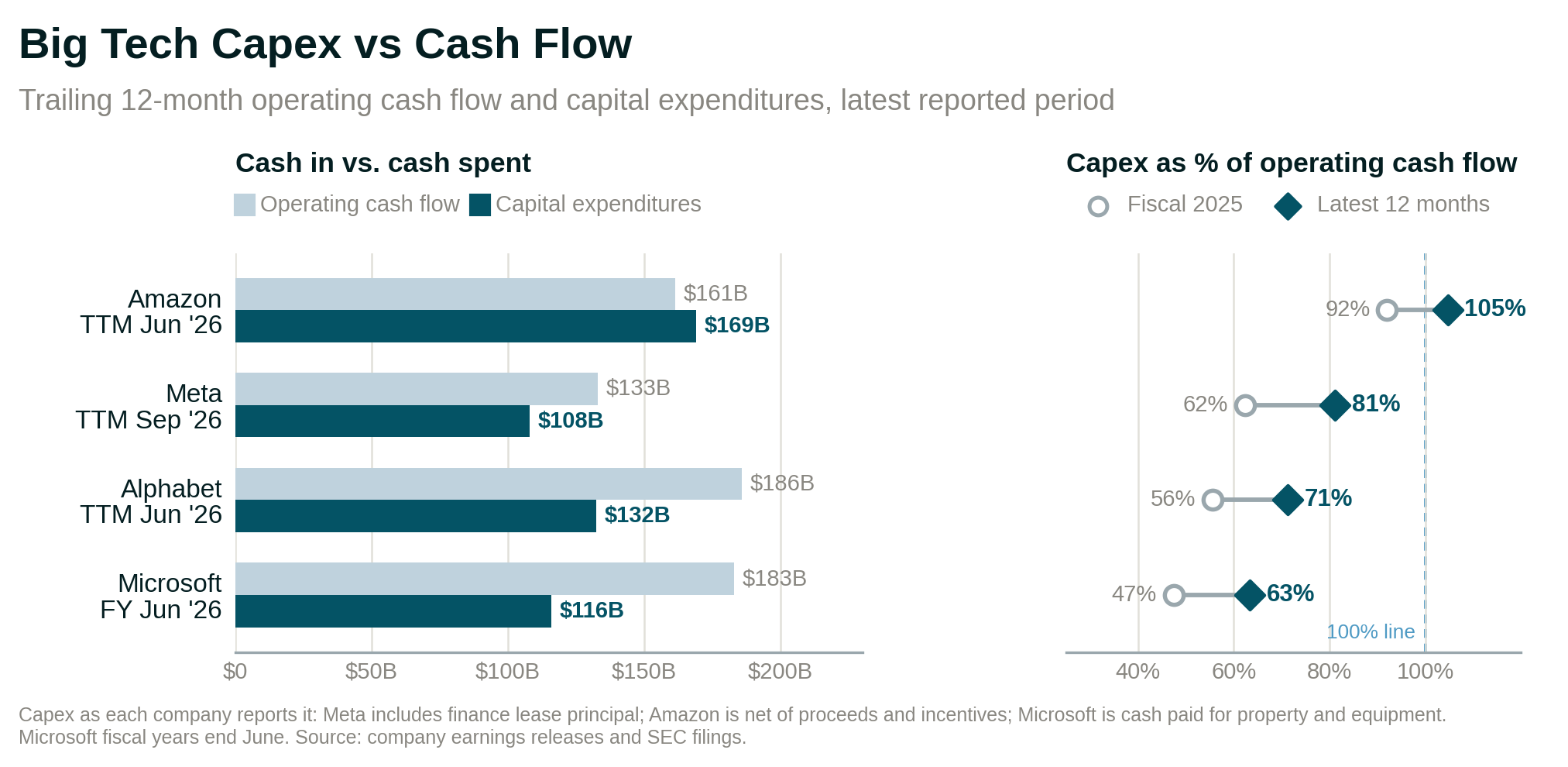
Data Source: Company earnings releases and SEC filings.
Chart and commentary by VestGen Investment Management.