WEEKLY MARKET SUMMARY
Global Equities: The S&P 500 suffered its worst week since April 2025 as the AI selloff spread across the market. Nvidia (NVDA) beat estimates and raised guidance on Tuesday, but the stock fell -22.9% for the week, including -14.0% on Friday after Reuters reported that SEC enforcement staff are examining potential accounting issues at the company. Anthropic (ANT) priced the largest IPO in Wall Street history on Wednesday night at $83 per share, above its expected range. The shares opened at $111.50 on Thursday before fading and fell roughly -8.5% on Friday amid the broader tech selloff. The S&P 500 fell for a seventh straight session and closed in correction territory, more than 11% below its October 6th record. For the week, the S&P 500 fell -8.6%, the Nasdaq dropped -10.0%, and the Dow finished -8.0% lower. Small caps also declined, with the Russell 2000 losing -7.5%. The VIX volatility index closed at 35.89, up 86% for the week. Overseas, Taiwan stocks fell -17.5% in their worst week since 1991, and the Stoxx 600 had its worst week since March. Developed Markets ended the week down -7.7%, while Emerging Markets fell -11.6%.
Fixed Income: Treasuries rallied as investors moved out of stocks, even as the Fed signaled more rate hikes. Minutes from the October meeting, released Wednesday, showed almost all officials expect further hikes will be needed, and a couple said a move larger than a quarter point could be considered in December if inflation data disappoint. Fed Governor Christopher Waller said a half-point hike is likely needed, while Governor Lisa Cook said Friday that a single hike is unlikely to be enough. The 10-year yield fell 23 basis points to 4.92%, the 2-year fell 25 basis points to 4.63%, and the 30-year eased to 5.34%. Markets still price a December hike as very likely, at about 92% on Friday per CME FedWatch, slightly below last week as the equity selloff raised questions about how far the Fed can tighten.
Commodities: Oil prices fell for a third straight week as shipments from the Persian Gulf recovered to near pre-war levels and Goldman Sachs forecast a 2 million barrel per day surplus in 2027. Prices rose slightly on Friday after Houthi missile attacks on Riyadh and reports of two tankers striking mines in the Strait of Hormuz. WTI ended the week around $83.98, and Brent fell to $92.57. Gold had its worst week since March as investors sold the metal to cover losses elsewhere and the dollar posted a fourth straight weekly gain. Gold fell -8.7% to its lowest level since September 2025, ending the week at $3,544 per ounce.
WEEKLY ECONOMIC SUMMARY
Retail Sales Hold Up, Factories Slow: Retail sales rose 0.2% in October, above the 0.1% forecast, after a 0.8% gain in September. Core retail sales, which exclude autos and gas, rose 0.6%, above the 0.4% forecast. Manufacturing was weaker. Industrial production fell -0.4% against expectations for no change, and regional surveys from the New York and Philadelphia Fed came in well below forecasts, at 7.8 and 6.3 respectively. Prices paid in the Philadelphia survey rose to 58.2 from 43.2.
Inflation Expectations Ease: The University of Michigan's consumer sentiment index was revised to 51.5 in November, slightly above the 51.0 forecast. Year-ahead inflation expectations fell to 3.7% from 4.7% in October, well below the 4.3% forecast, while 5-year expectations were 3.3%. Fed Governor Christopher Waller suggested that, with consumers expecting at least 3% inflation as the new normal, a 50 basis point hike is warranted to “shock” them into lowering expectations.
Earnings Update: Nvidia (NVDA) reported revenue of $115.8 billion, up 103% from a year earlier and above the roughly $109 billion consensus, with data center revenue of $107.6 billion. Adjusted earnings of $2.68 per share topped the $2.47 estimate, and fourth quarter revenue guidance of $130 billion was well above expectations of about $125 billion. The strong results were an afterthought, however, amidst the fallout from Jensen Huang’s departure. The board said it does not intend to reinstate Jensen Huang as CEO and has hired Heidrick & Struggles to lead the search for a permanent replacement. In retail, Walmart (WMT) beat estimates and raised its full-year outlook, but shares slipped about -1% Thursday. Home Depot (HD) fell -2.5% Tuesday on weak year-end guidance, while Target (TGT) raised its full-year earnings outlook. TJX (TJX) was one of the few gainers, up 3.9% for the week. After this week’s market pullback, the S&P 500's forward P/E has fallen from about 30 to roughly 21, below its five-year average.
The Week Ahead: Markets are closed Thursday for Thanksgiving and close early at 1:00 p.m. on Friday, but Wednesday brings a heavy slate of data. The second estimate of third quarter GDP, October personal income and spending, and the PCE price index, the Fed's preferred inflation measure, are all released Wednesday morning, along with durable goods orders, jobless claims and new home sales. The Fed's Beige Book follows that afternoon. Flash PMIs come out Monday and consumer confidence on Tuesday. Earnings season is wrapping up with Dell (DELL), HP (HPQ), Workday (WDAY) and Autodesk (ADSK) reporting Tuesday after the close, following Hewlett Packard Enterprise (HPE) on Monday. Retail results continue with Best Buy (BBY), Dollar Tree (DLTR) and Dick's Sporting Goods (DKS) on Tuesday morning, ahead of the start of the holiday shopping season on Black Friday.
CHART OF THE DAY
The Chart of the Day tracks how far the S&P 500 and Nasdaq have fallen from their October 6th highs. Including dividends, the S&P 500 ended Friday 11.5% below its peak after falling for seven straight sessions, officially entering correction territory. The Nasdaq, more heavily weighted toward the technology and AI stocks at the center of the selloff, has fallen 18.1%, about 2 points from the 20% threshold that defines a bear market. While the speed of the decline is unsettling, history offers some perspective. Of the 26 completed S&P 500 declines of 10% or more from a record high since 1928, 14 stopped short of a bear market, and the typical correction bottomed around 13% and recovered to its prior high within about seven months of the peak. Earlier this year, the Nasdaq fell nearly 13% by late March and reached a new high just over two weeks later.
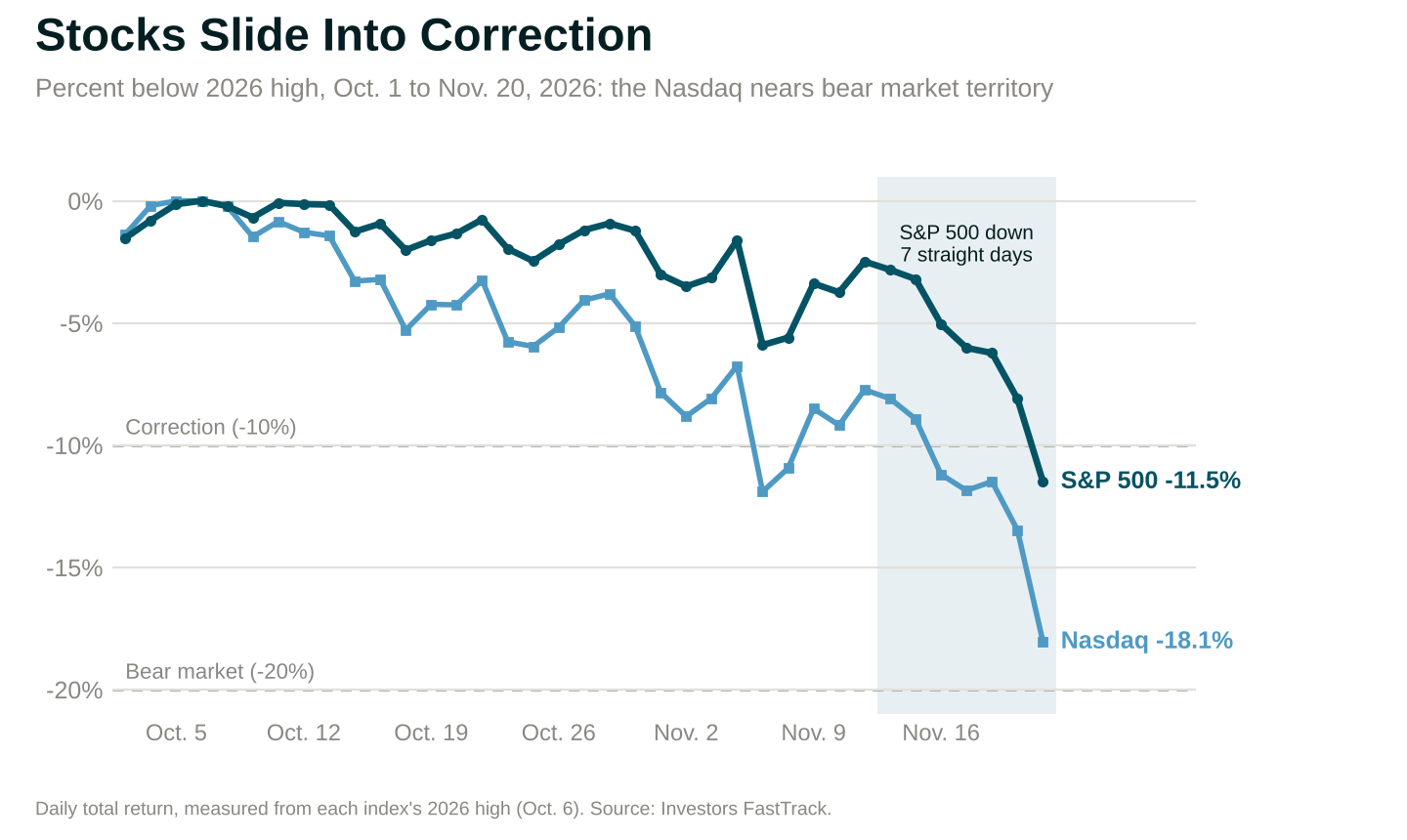
Chart and commentary by VestGen Investment Management. Data from Investors FastTrack.