
Markets Reassess Rates After Softer Economic Data
WEEKLY MARKET SUMMARY
Global Equities: Stocks were mixed as investors grappled with higher bond yields before soft economic data on Friday brought some relief. The S&P 500 slipped -0.3% and the Dow Jones Industrial Average fell -1.3%, while the Nasdaq rose 0.5%, outperforming the other major indexes for the sixth straight week. Technology again did the heavy lifting, with the Nasdaq 100 touching an intraday record high on Friday. Breadth remained narrow, as small caps recovered most of their losses on Friday, but the Russell 2000 still finished the week down -0.2%. Overseas markets lagged, with developed market stocks falling -1.5% and emerging markets declining -0.5%.
Fixed Income: The global bond sell-off reached a new extreme midweek before easing on softer US data. The 10-year Treasury yield climbed above 5.34% intraday on Thursday, its highest level since 2002, while the 30-year yield touched roughly 5.68%. Yields dropped sharply after Friday's jobs report but drifted back up through the session, and the 10-year ended the week near 5.28%. Long-term yields once again rose faster than short-term yields, with the 2-year finishing near 4.83%, up only about 2 basis points, widening the gap between the 2-year and 10-year yields to 45 basis points from 36 basis points a week earlier. The average 30-year fixed rate mortgage jumped to 7.28%, up from 7.03% the prior week in what was the largest single-week increase in four years.
Commodities: Oil prices swung sharply as stalled US-Iran talks collided with a coordinated push to bring down fuel costs. The US offered up to 40 million barrels from its strategic reserve on Tuesday, and on Friday the G-7 and its partners agreed to release up to 100 million barrels of emergency crude and diesel stocks over the next four months, with an initial focus on diesel. The announcement followed a Trump administration threat to cut off US diesel flows to Europe unless European governments tapped their own stockpiles. US West Texas Intermediate fell to a one-month low of $88.06 intraday on Friday before settling at $91.11 per barrel, down -1.4% for the week. Brent crude, which rolled to the December contract during the week, settled at $102.25, roughly unchanged on a comparable basis, leaving the spread between the two benchmarks near $11 per barrel even as Middle Eastern crude exports recovered close to prewar levels.
WEEKLY ECONOMIC SUMMARY
Payrolls Stall: The labor market cooled more than expected in September. Nonfarm payrolls rose just 29,000, well below the roughly 84,000 consensus, and revisions subtracted a combined 60,000 jobs from prior months. The unemployment rate rose to 4.2% from 4.1%, though partly because more people entered the labor force, as participation moved higher. Wage growth continued to slow, with average hourly earnings up 0.1% for the month and 3.0% from a year ago, the lowest annual pace since May 2021 and the sixth straight month of pay gains failing to keep pace with inflation.
PCE Inflation Softens: August PCE inflation came in at 3.4% year-over-year versus a 3.3% consensus, unchanged from a downwardly revised July. Core PCE was also soft at 0.2% for the month and 3.0% year over year. The data was impacted by revised measurement methods that BEA applied retroactively, resulting in lower component inflation readings for financial management services, computer software and accessories, and legal services. Combined with the weak jobs data, the soft PCE reading gave doves at the Fed more rationale to argue for an October rate hike pause.
Inflation Pressures Show Up in Other Data: The ISM manufacturing index held at 54.5 in September, its ninth straight month of expansion, with new orders rising to 55.3, but the prices paid index jumped 6.8 points to 77.9, near its March level at the start of the Iran war. Respondents cited steel and aluminum tariffs and rising petroleum-based input costs, and no industry reported paying lower prices for raw materials. Consumers are feeling the squeeze as well. The Conference Board's consumer confidence index fell 6.7 points to 81.9, and consumers' assessment of current business conditions turned negative for the first time since September 2024, with mentions of high prices, particularly for gas and oil, rising to new highs.
The Week Ahead: Minutes from the September 15-16 FOMC meeting, which delivered the first rate hike in three years, arrive Wednesday, followed by the University of Michigan's preliminary October consumer sentiment survey on Friday.
CHART OF THE DAY
The Chart of the Day shows the dramatic collapse in the probability of an October interest rate hike, as derived from Fed Funds futures markets and reported by CME Group. Markets entered the week with a Fed hike being priced in a strong likelihood at over 70%. Comments from the New York Fed’s John Williams shifted the odds, followed by soft PCE inflation data following the BEA’s methodology revisions. The weak September jobs report and the revisions to August’s strong data pushed the odds down even further. With the November election adding further complication and uncertainty, pushing the rate decision seems to be the most prudent path for the Fed, and the most likely outcome.
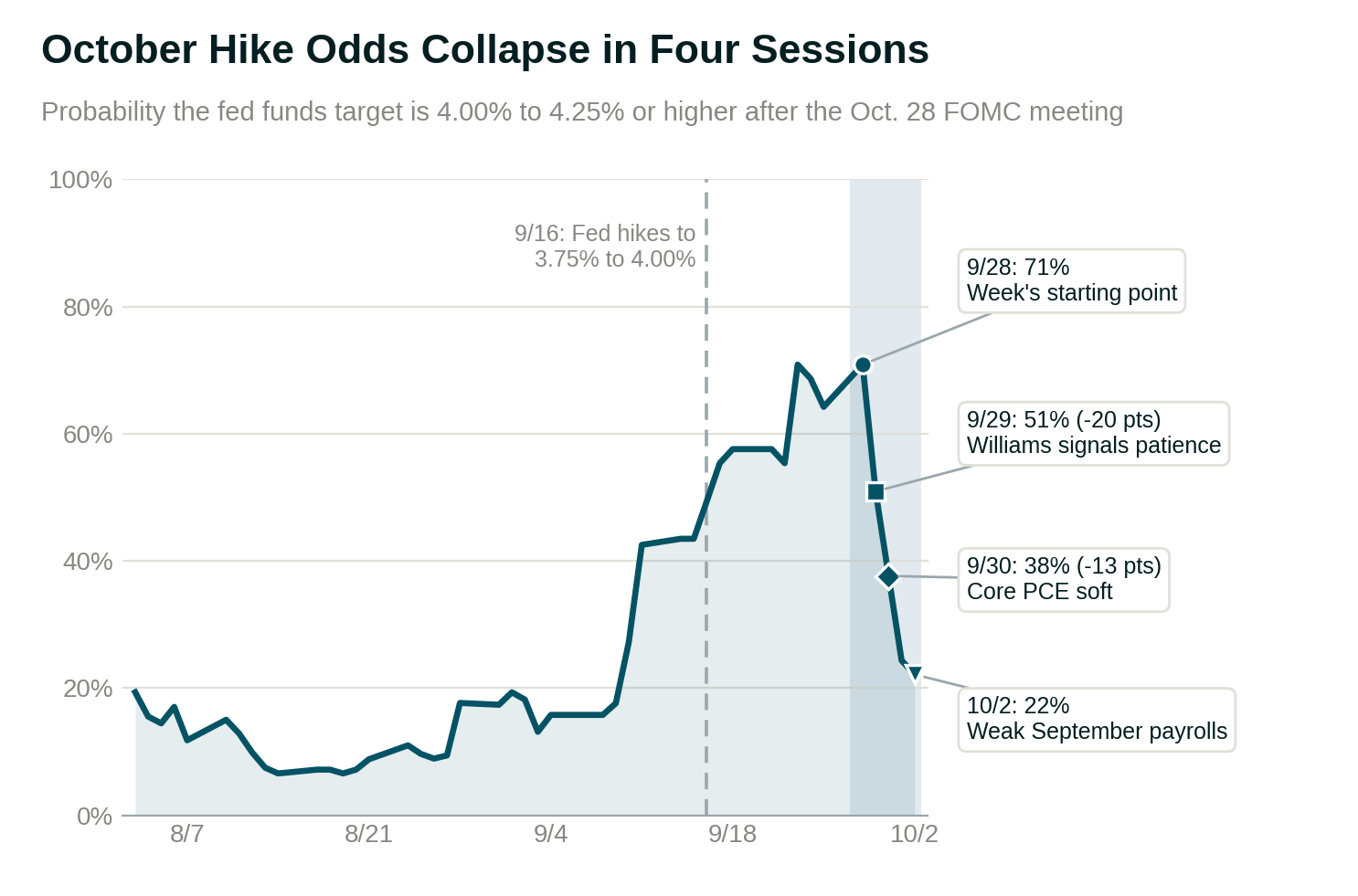
Data Source: CME FedWatch tool.
Commentary by VestGen Investment Management.
