
Markets Rally Despite Rising Interest Rate Pressure
WEEKLY MARKET SUMMARY
Global Equities: Stocks rebounded as easing oil prices helped offset another punishing week in the bond market. The S&P 500 gained 1.2% to finish within 0.7% of its all-time high set last month, while the Nasdaq rose 2.1% and the Dow Jones Industrial Average added 0.3%, snapping a three-week losing streak. Market breadth remained weak, with tech stocks driving most of the gains. Rate-sensitive small caps lagged again as yields climbed, with the Russell 2000 slipping -0.8% during weekly trading. Developed market stocks ended the week 0.6% and emerging markets gained 1.4% as lower crude prices provided a boost.
Fixed Income: The global bond sell-off intensified as strong economic data and hawkish Fed commentary pushed long-term yields to levels not seen in nearly two decades. The 10-year Treasury yield touched its highest level since 2007 on Thursday before ending the week at 5.17%, while the 30-year yield climbed to roughly 5.49%, its highest since 2004. Long-term yields rose faster than short-term yields, steepening the curve and widening the gap between the 2-year (4.81%) and 10-year yields to roughly 36 basis points from about 25 basis points a week earlier. Mortgage rates followed, with Freddie Mac's 30-year fixed rate moving back above 7% to 7.03%.
Commodities: Crude oil benchmarks diverged sharply during the week. US West Texas Intermediate fell roughly 8% to settle at $92.41 per barrel on Friday, pressured by hopes that US and Iranian negotiators could agree on a phased path toward reopening the Strait of Hormuz. A rumored ban on US diesel exports and the roll to lower-priced November futures contracts also contributed to WTI’s decline. Brent crude, the international benchmark, proved stickier as Houthi attacks on Saudi Arabia kept supply concerns elevated, finishing the week up less than 1% at $104.32 and leaving the spread between the two benchmarks near its widest level since May at roughly $12 per barrel.
WEEKLY ECONOMIC SUMMARY
Business Activity Surges: US business activity accelerated sharply in September according to S&P Global's flash PMI surveys. The composite PMI rose to 58.4 from 56.0, a 62-month high, as the services index climbed to 58.7, its strongest reading in nearly five years, and the manufacturing PMI jumped to 57.0 from 53.9, well above the 53.6 consensus and the largest improvement in factory conditions since May 2022. Hiring picked up at the fastest pace in more than four years. Market reaction was negative, however, due to the hawkish implications in the underlying data. Input costs rose at the fastest rate since October 2022 on higher fuel and transport costs, while rising order backlogs and lengthening supplier delivery times are indicative of elevated inflation.
Businesses Invest, Households Worry: Durable goods orders were virtually unchanged in August at $338.6 billion following a 0.9% gain in July, beating estimates of a 0.3% decline. Excluding transportation, orders rose 0.3%, and core capital goods orders, a proxy for business equipment investment, jumped 1.6%. Households are far less upbeat. The University of Michigan's final September consumer sentiment index fell to 48.1 from 51.7, a four-month low and 15% below January, as year-ahead inflation expectations jumped to 4.6% from 4.0%, the highest since June, and five-year expectations edged up to 3.4%. Notably, buying conditions for durable goods improved as some households moved to lock in purchases ahead of anticipated price increases, which may be pulling some demand forward.
US-China Summit: Chinese President Xi Jinping's three-day state visit to Washington produced warm words but limited substance. The primary policy outcome was a two-month extension of the US-China trade truce that had been set to expire in November, which Treasury Secretary Scott Bessent said would give both sides more time to make progress on economic issues. Core disputes over tariffs, Chinese purchase commitments, rare earth supplies and technology restrictions were pushed to the next round of negotiations, with US officials noting that China is lagging on some agricultural purchase pledges and rare earth deliveries. Despite the attendance of major AI industry CEOs, there was no announcement on a development slowdown or guardrails, with President Trump’s comments mostly concerned with renaming AI to “SI”, short for Super Intelligence.
The Week Ahead: A busy week of data will test the case for another Fed hike, with markets pricing roughly a two-in-three chance of a move at the October 28 meeting. August PCE inflation arrives Wednesday alongside the final estimate of second quarter GDP, followed by the September jobs report on Friday, where consensus expects roughly 100,000 new jobs.
CHART OF THE DAY
The Chart of the Day tracks the gap between 10-year and 2-year Treasury yields. Through mid-September, the curve flattened sharply as short-term yields rose in anticipation of the Fed's first rate hike in more than three years. The spread fell to 20 basis points on September 21st, its narrowest level of the year. The past week reversed that move, however, as long-term yields rose four times as fast as short-term yields amid hot PMI data and a global bond sell-off, and the spread widened back to 36 basis points. This type of move, where long rates rise faster than short rates, typically reflects investors demanding more compensation for inflation and rising fiscal risks.
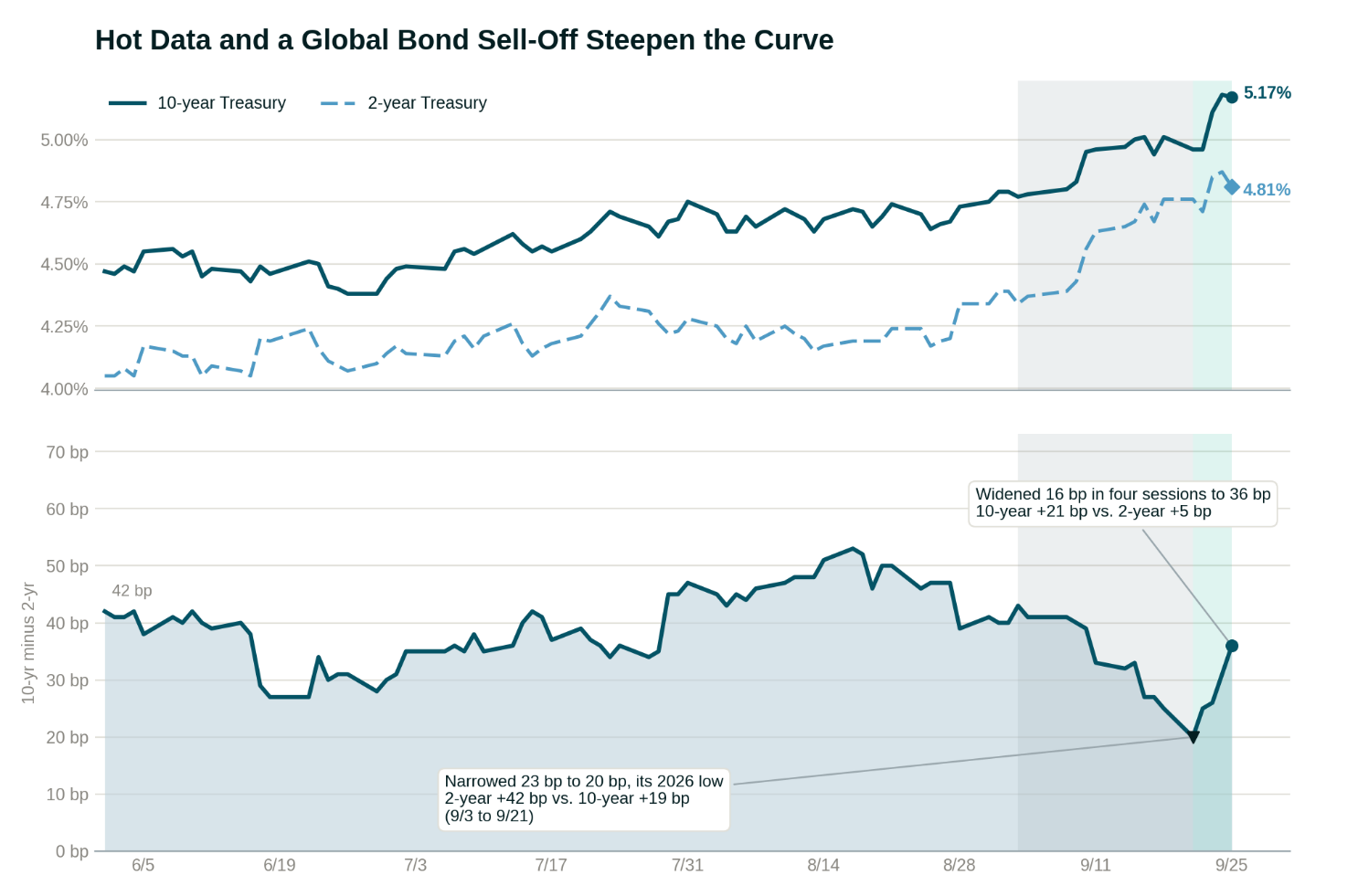
Data Source: US Federal Reserve.
Commentary by VestGen Investment Management.