
Fed Rate Hike Reshapes Market Outlook
WEEKLY MARKET SUMMARY
Global Equities: Stocks were mixed during a busy week for central bank policy decisions. Market breadth was notably weak, as mega-cap semiconductors carried the market. The S&P 500 ended the week relatively unchanged at -0.1%, while the Dow Jones Industrial Average finished -1.7% lower and the Nasdaq gained 0.7%. Rate-sensitive small caps lagged throughout as yields rose, with the Russell 2000 slipping -1.5% during weekly trading. Foreign stocks struggled as the US dollar strengthened, with developed market stocks ending the week down -1.6% and emerging markets losing -1.2%.
Fixed Income: Treasury yields pushed to fresh multiyear highs ahead of the Fed meeting but eased after the Fed delivered the expected rate hike. The 10-year Treasury yield ended the week just under 5%. The yield curve flattened, narrowing the gap between 2-year and 10-year yields to roughly 25 basis points.
Commodities: Crude oil stayed elevated on persistent supply risk from the Iran conflict, though prices eased into Friday. A shutdown of a crucial Saudi pipeline following a drone attack drove prices higher, but relief came after Saudi Aramco was able to bring additional supply to the market via alternate supply routes. US West Texas Intermediate settled near $99.50 per barrel as of Friday afternoon after trading above $106 during the week.
WEEKLY ECONOMIC SUMMARY
Fed Hikes: The Federal Reserve raised its benchmark federal funds rate by 25 basis points to a target range of 3.75% to 4.00%, its first increase in more than three years, in a unanimous 12 to 0 vote. The move, widely expected after recent data showed firm inflation and resilient demand, was framed by Chair Kevin Warsh as necessary to deliver a timelier return to the 2% target amid energy-driven price pressure. The updated Summary of Economic Projections (the “Dot Plot”) showed most officials expecting at least one additional hike this year, with the year-end median in the 4.00% to 4.25% range, and projected PCE inflation of 3.7% for 2026 easing to 2.3% in 2027.
Retail Sales Rebound: Consumer spending proved resilient in August. Advance retail and food services sales rose 1.2% for the month to $773.9 billion, well above the roughly 0.7% consensus and the strongest monthly gain since March. Sales were up 6.0% from a year earlier, and July's figure was revised to a 0.5% decline from an initially reported 0.6% drop. The strength, achieved despite higher fuel costs and elevated borrowing rates, prompted several economists to raise third quarter growth estimates and reinforced the case for the Fed's move. The figures are nominal and not adjusted for inflation, so part of the gain reflects higher prices rather than greater volumes. Still, the data shows that despite souring survey data, consumers are still spending.
Bank of Japan Lifts Rates to a 31-Year High: The Bank of Japan raised its policy rate by 25 basis points to 1.25%, the highest level since 1995, in a split 7 to 2 vote. Governor Ueda cited the risk of underlying inflation overshooting the 2% target as firms grow more aggressive on wages and prices. Despite the hike, the yen weakened past 157 per dollar as markets focused on the dissents and on continued dollar strength, underscoring how far Japanese policy still lags the rest of the developed world.
The Week Ahead: With the Fed's decision in the rear-view mirror, a lighter week of economic data awaits, highlighted by S&P Global manufacturing and services PMIs, durable goods orders, and consumer sentiment data.
CHART OF THE DAY
The Chart of the Day shows the shift in the median interest rate projection from the Federal Reserve’s Summary of Economic Projections (the “Dot Plot”) since March of 2026. In March, the median participant expected the Fed funds rate to drift down toward 3.4% by the end of 2026 and 3.1% in 2027. At this month’s FOMC, however, energy-driven inflation has the Fed expecting to hold rates at 4.1% through year-end 2027. For equities, a risk-free rate parked near 4% with rising real yields is a headwind to valuations, most acutely for the high-multiple growth stocks and rate-sensitive small caps.
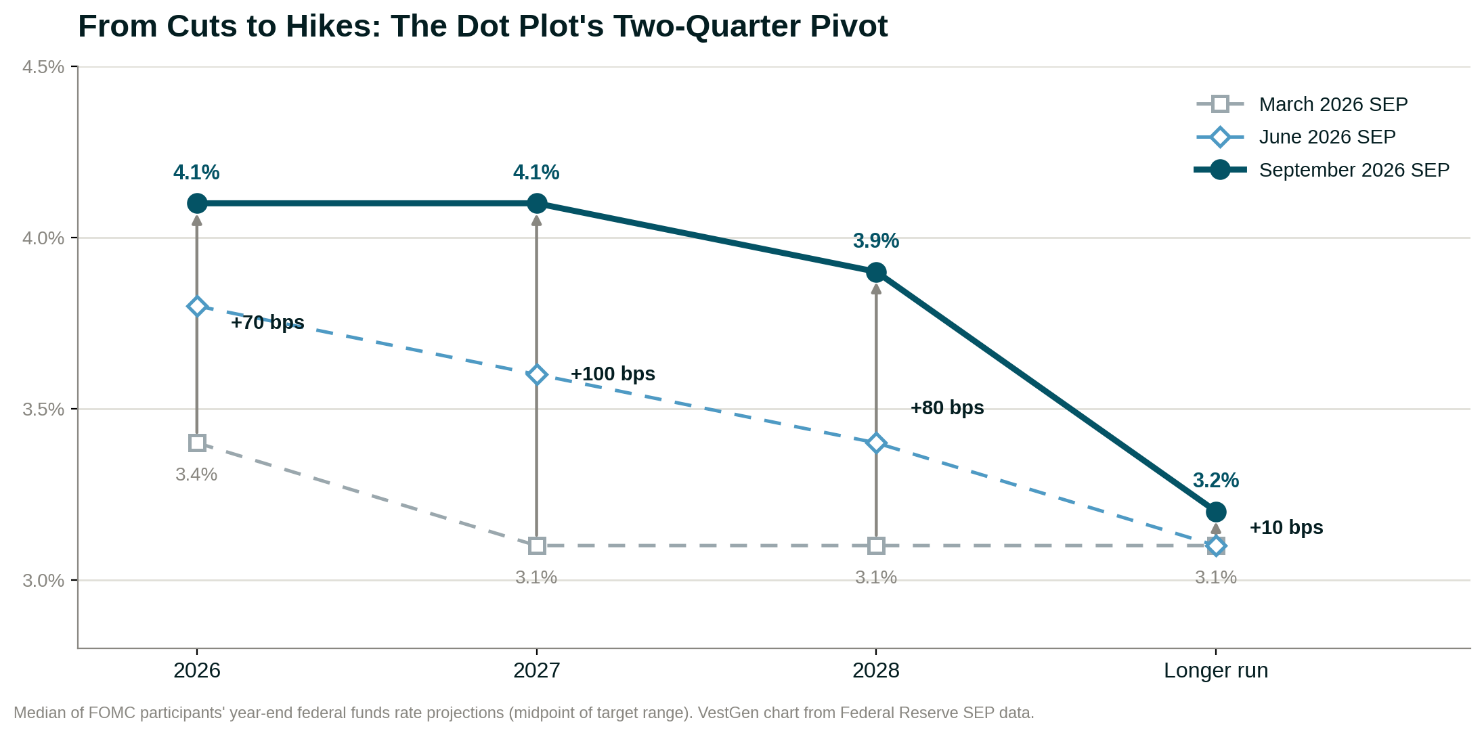
Data Source: US Federal Reserve.
Commentary by VestGen Investment Management.