WEEKLY MARKET SUMMARY
Global Equities: Volatility picked up as stocks reacted to mid-term elections and the potential implications on the AI trade. Democrats won control of both the House and Senate on Tuesday, and stocks initially rallied on Wednesday, although most of the gains were in defensive sectors rather than AI-related stocks. Stocks pulled back on Thursday as chipmakers sank on concerns that a Democratic Congress, along with newly elected officials in states where opposition to data centers has grown, could bring tighter regulation and slow the AI infrastructure buildout. The Philadelphia Semiconductor Index fell -12.2%, its biggest one-day drop since April 2025, the Nasdaq dropped ‑5.5%, and the S&P 500 lost ‑4.4%, its worst day since April 2025, erasing about $3 trillion in market value. Chipmakers led a partial rebound on Friday. For the week, the S&P 500 fell ‑2.7%, its worst week since June, the Nasdaq dropped ‑3.4% for its fourth straight weekly loss, the Dow slipped ‑0.9%, and the Russell 2000 declined ‑2.0%. The VIX jumped 32% to 25.6. Overseas, Developed Market stocks were down -1.4% for the weekly session, while Emerging Markets slipped -2.8%.
Fixed Income: Treasuries rallied as investors sought safety during Thursday’s selloff, then gave back some of those gains after Friday’s strong jobs report. The 10-year yield ended the week at 4.86%, down 8 basis points from 4.94% a week earlier, while the 2-year yield fell 5 basis points to 4.51%. Rate expectations swung with the headlines. Market-implied odds of a quarter-point hike at the December 8-9 meeting fell to 67% on Thursday from 83% on Wednesday as the tech selloff deepened, then rebounded to about 78% after the jobs data.
Commodities: Oil posted one of its steepest weekly declines in years as the election results raised hopes for a de-escalation of the U.S.-Israeli war with Iran. WTI and Brent both fell about -13% for the week, with WTI ending at $90.83 and Brent at $98.32. Gold staged a sharp recovery, rising about 4.5% to roughly $4,080 per ounce for its strongest weekly gain since August, as lower Treasury yields and safe-haven demand during the tech selloff supported the metal.
WEEKLY ECONOMIC SUMMARY
Jobs Surprise: Nonfarm payrolls rose 165,000 in October, nearly triple the 59,000 economists expected, and the unemployment rate dipped to 4.1% from 4.2%. Revisions added a combined 84,000 jobs to the prior two months, with August raised to 186,000 and September to 60,000 from an initial 29,000. Professional and business services added about 70,000 jobs, healthcare about 42,000, and transportation and warehousing about 25,000. Average hourly earnings rose 0.4% for the month and 3.1% from a year ago. The report was the first major economic release since the midterms and strengthens the case for a December rate hike.
Manufacturing Accelerates: The ISM manufacturing index rose to 55.5 in October from 54.5, beating the 54.6 forecast and marking a 10th straight month of expansion. The production index reached 59.0, its highest since November 2021, while the prices index remained elevated at 75.2, its ninth straight reading above 70. The services index slipped to 54.5 from 54.9, slightly below the 54.8 forecast, as new orders cooled to 55.9 from 59.8, though the sector has now expanded for 28 straight months and its prices index held high at 73.0.
Earnings Update: AI hardware results were strong, but investors punished any shortfall in guidance. AMD (AMD) reported record revenue of $13.4 billion, up 45%, as data center sales nearly doubled to a record $8.5 billion, and guided fourth quarter revenue to about $17 billion, above the roughly $16.3 billion analysts expected. CEO Lisa Su said she now expects revenue to grow more than 80% in 2027. Shares rallied on the results but fell about ‑17% in Thursday’s rout before rebounding 11% on Friday. Qualcomm (QCOM) fell ‑9.5% on Thursday after its smartphone chip sales outlook missed estimates. Apple (AAPL) reported September quarter revenue of $114.5 billion, up 12% and ahead of the $113.4 billion estimate, in John Ternus’s first quarter as CEO, with iPhone revenue reaching a September quarter record. However, services growth slowed to its weakest pace since September 2022, and a gross margin forecast of 45% to 46% fell short of the 46.3% consensus, sending shares lower. Palantir (PLTR) beat estimates as U.S. commercial revenue topped U.S. government revenue for the first time and raised its 2026 revenue outlook to about $8.5 billion, but shares slipped on slowing new contract bookings and valuation concerns.
The Week Ahead: The October Consumer Price Index is due Tuesday, with economists expecting headline prices to rise 0.3% and core prices 0.2% for the month, after gains of 0.6% and 0.3% in September. Year-over-year comparisons will not be available, as last October’s report was never published due to the government shutdown. The Producer Price Index follows on Friday. AI-related earnings continue with CoreWeave (CRWV) on Tuesday and Cisco (CSCO) and Applied Materials (AMAT) on Thursday.
CHART OF THE DAY
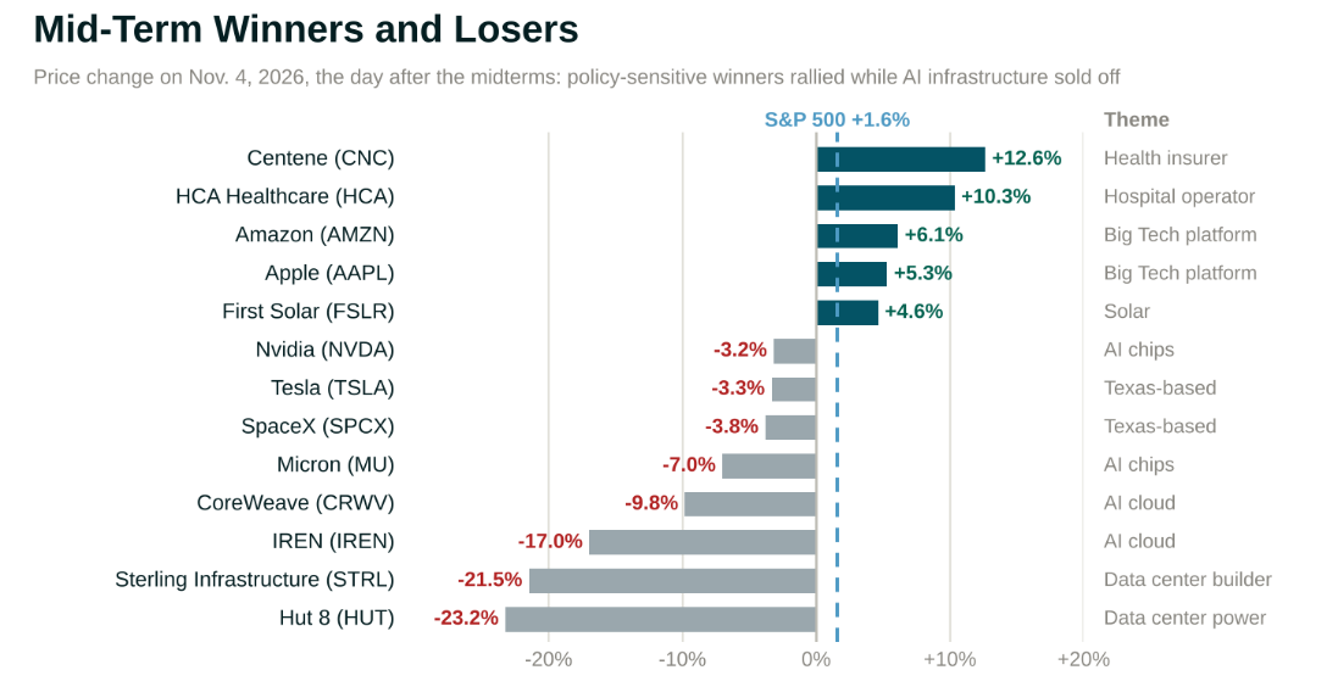
The Chart of the Day shows the immediate post-election reaction to various investment themes, with selected sample stocks, the day after the Democrats won control of both the House and Senate. Health insurers and hospital operators led the gains, rising more than 10%, as investors positioned for a more supportive policy backdrop for health care. Solar stocks rallied on expectations of a policy shift toward clean energy, and the largest tech platforms gained on expectations that a slower AI buildout would ease component cost pressures. The losers were the companies most dependent on rapid data center construction. AI cloud providers, data center builders and their power suppliers fell between -10% and -23% on concerns that new limits could slow the buildout, particularly in Texas, which holds about 27% of US data center power capacity. The takeaway is that investors now see the AI buildout as exposed to political risk, while sectors aligned with the new Congress’ priorities stand to benefit.
Data Source: Investors FastTrack, CNBC. Chart and commentary by VestGen Investment Management.