Technology Stocks Slide as Inflation Pressures Mount
WEEKLY MARKET SUMMARY
Global Equities: A sharp selloff in semiconductor and AI-linked shares offset a broad rotation into the rest of the market. The PHLX Semiconductor Index fell for eight straight sessions through Thursday, its longest losing streak since 2015, leaving it down 15.2% from its October 2 close as investors concerns mounted over Chinese competitors undercutting heavy-spending AI companies. Concerns over debt-heavy AI infrastructure added to the pressure, with cloud provider CoreWeave (CRWV) falling 15.5% on Wednesday as its bond yields surged, leading to the worst day since July for the S&P 500 and Nasdaq. Beneath the surface, however, the market was much healthier as value-oriented stocks outperformed. For the week, the S&P 500 fell 1.9% and the Nasdaq Composite fell 4.5%, both their worst weeks since June, while the Dow rose 0.7% for a second straight weekly gain. Small caps also struggled, with the Russell 2000 down 3.0%. Overseas, the chip selloff hit Asian markets hardest, with South Korea's chip-heavy KOSPI falling 5.5% on Tuesday alone. Developed market stocks rose 0.2% for the week, while emerging markets fell 5.9%.
Fixed Income: Treasury yields shrugged off economic data, staging a dramatic reversal during the week. The 10-year yield climbed to about 5.33% on Wednesday following the hotter than expected CPI report, nearing the 24-year highs set last week, before tumbling roughly 13 basis points on Thursday to around 5.09%, its lowest close since September 22. The rally came despite a much hotter producer price report, as the selloff in technology stocks drove demand for safer assets, retail sales excluding gasoline came in soft, and Fed officials signaled no urgency to raise rates again in October. The 30-year bond posted its biggest one-day yield decline since February. The 10-year yield finished the week near 5.10%, down about 14 basis points from 5.24% a week earlier, marking back-to-back weekly declines for the first time since June.
Commodities: Oil prices surged to end the week as supply threats mounted on several fronts. Brent rose 3.7% on Friday to settle at $109.86 per barrel, its highest close since May 19, after briefly touching $110, following a missile attack near a key Saudi oil export port, intensified Iranian attacks on shipping in the Strait of Hormuz, and a Ukrainian drone strike that shut a primary unit at a major Russian refinery. US West Texas Intermediate rose 3.5% to $101.41, its highest close since September 17, building on a more than 3% gain Thursday after a larger than expected drop in US crude inventories as hurricane-related shutdowns cut Gulf production. For the week, WTI gained 10.4% and Brent 4.9%. Emergency measures did little to cool prices, as the International Energy Agency pledged to release the remaining 100 million barrels under its March agreement and the US offered up to 17 million barrels from the Strategic Petroleum Reserve. Diesel remains the pressure point, with US prices holding above $6.20 per gallon, near a record high. Gold climbed toward $4,180 per ounce on Friday as the dollar weakened.
WEEKLY ECONOMIC SUMMARY
Energy Pushes Consumer Inflation Higher: The Consumer Price Index rose 0.6% in September, in line with expectations, lifting the annual rate to 3.7% from 3.4% in August and above the 3.6% forecast. Gasoline prices jumped 9.1% and accounted for more than half of the monthly increase, while airfares are up 22% from a year ago, largely reflecting higher jet fuel costs. More concerning for the Fed, core CPI, which excludes food and energy, rose 0.3% for the month and 2.6% from a year ago, both a tenth of a point above forecasts. This was the last CPI report before the November 3 midterm elections, and it sets the 2027 Social Security cost-of-living adjustment at 3.6%, up from 2.8% in 2026.
Producer Prices Surge: The Producer Price Index jumped 1.3% in September, more than double expectations and the largest monthly increase since March 2022, pushing the annual rate to 6.3%, the highest since December 2022. Energy prices at the producer level rose 10.8%, led by a 20.3% surge in gasoline, and goods prices posted their largest monthly gain since the series began in 2009. Higher energy costs are increasingly showing up as input costs further down the supply chain. Diesel prices paid by businesses jumped 21.0%, transportation and warehousing services rose 3.4%, and core producer prices, which exclude food, energy, and trade services, rose 0.5% for the month and 5.0% from a year ago. Retailers absorbed part of the shock, with margins on retail fuel sales falling 30.3%, which may delay, but is unlikely to prevent, further pass-through to consumers.
Gas Prices Lift Retail Sales: Retail sales rose 0.8% in September, well above the 0.3% forecast, and August was revised up to a 1.3% gain. Much of the strength reflected higher prices rather than more spending, as sales at gas stations jumped 6.4%. Excluding gas stations, sales rose just 0.2%, and the control group, which feeds into GDP, edged up only 0.1% versus expectations for 0.3%. Adjusted for inflation, sales volumes rose about 0.1%, consistent with consumers trading down as fuel costs squeeze household budgets. Restaurant sales, the only services category in the report, rose 1.1%.
Earnings Update: Third quarter earnings season got underway with mixed results from the largest banks. Goldman Sachs (GS) led the group, earning $17.01 per share versus $12.25 a year ago on net revenue of $18.68 billion, up 23%, driven by strong equities trading. JPMorgan (JPM) posted a rare miss, its first in nearly three years, as weaker fixed income trading and securities losses offset growth in loans and net interest income. Bank executives broadly cautioned that rising interest rates and sticky inflation could weigh on results ahead.
The Week Ahead: Earnings season picks up with several notable names reporting. Netflix (NFLX) reports Tuesday after the close, following GE Aerospace (GE), General Motors (GM), RTX (RTX), and 3M (MMM) earlier in the day. Tesla (TSLA) and Meta Platforms (META) report Wednesday, followed by Procter & Gamble (PG), Union Pacific (UNP), and Blackstone (BX) on Thursday and American Express (AXP) on Friday. Fed officials enter their pre-meeting blackout period on Saturday ahead of the October 27-28 meeting.
CHART OF THE DAY
The Chart of the Day traces how this year's energy shock is moving through the producer pipeline. In September, energy prices at the producer level rose 10.8% and are up 35.4% from a year ago, while raw materials, led by a 28.3% jump in crude petroleum, rose 8.4% and are up 21.5%. Those costs are now showing up in what businesses pay for their inputs. Processed goods such as diesel and jet fuel are up 14.1% over the past year, the most since August 2022, and services purchased by businesses have risen 6.3% as freight costs and wholesale margins climb. So far, the prices producers charge have absorbed only part of the increase, with headline PPI up 6.3% and core PPI, which excludes food, energy, and trade services, up 5.0%. The gap between what producers pay and what they charge points to continued pressure on profit margins, and potentially on consumer prices, in the months ahead.
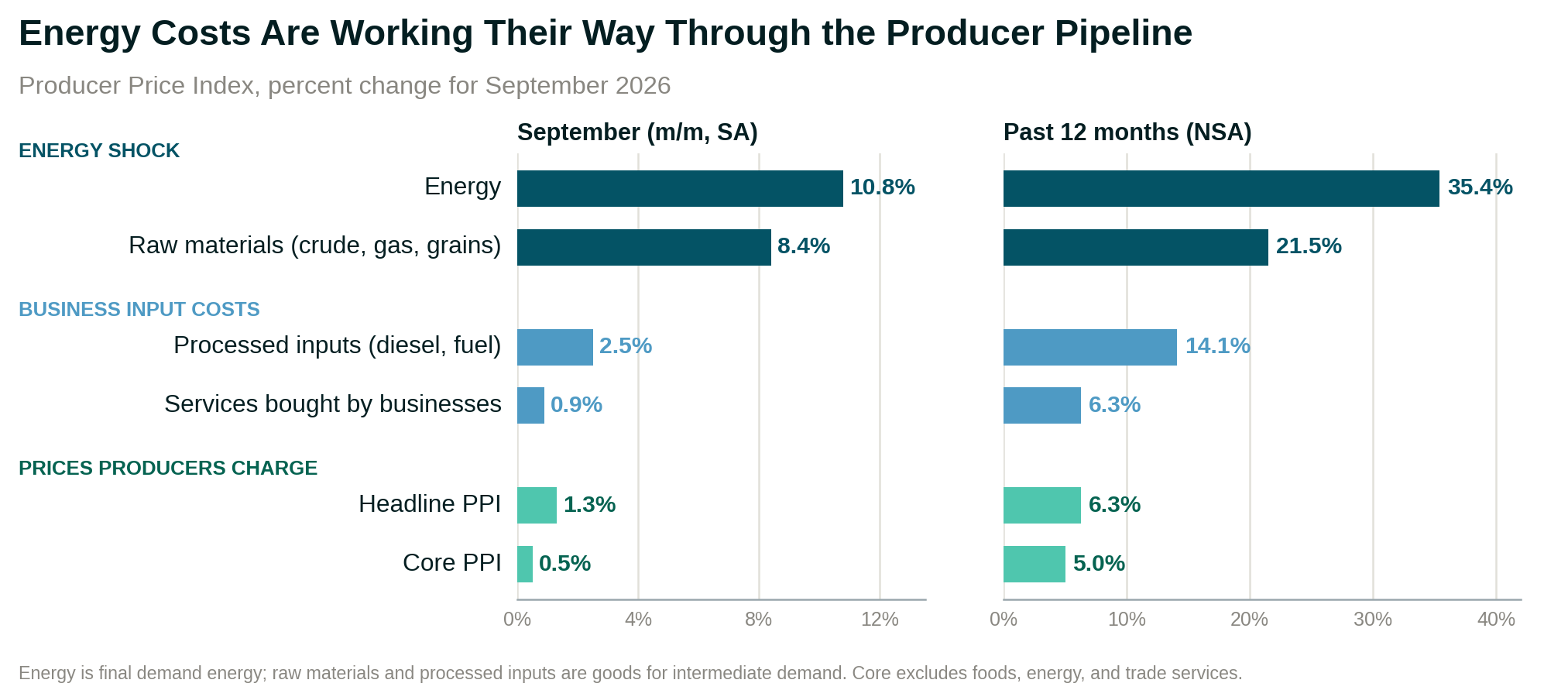
Data Source: US Bureau of Labor Statistics.
Commentary by VestGen Investment Management.