
Stocks Climb as Treasury Yields Reach New Highs
WEEKLY MARKET SUMMARY
Global Equities: Stocks overcame a volatile week to post solid gains, as investors looked past 24-year highs in long-term bond yields and some AI volatility ahead of the start of third quarter earnings season. The S&P 500 set a record close on Tuesday and finished the week up 1.2% while the Dow Jones Industrial Average gained 1.0% and the Nasdaq Composite rose 0.6%. Technology stocks gave back ground on Thursday after a Financial Times report that OpenAI told investors its annualized revenue was nearing $50 billion, roughly $20 billion below figures previously reported. The report sent the Nasdaq down 1.3% for the day and pressured AI-linked names, although the revision was due to accounting methodology and not a sudden drop in demand. The broader market held up better, with most S&P 500 sectors rising that day, led by energy and consumer staples, and technology rebounded on Friday. Rate-sensitive small caps lagged again, with the Russell 2000 slipping -0.9% for the week. Developed market stocks ended the week down -0.5% and emerging markets -1.3%.
Fixed Income: Long-term Treasury yields climbed to their highest levels since 2002 early in the week before easing into Friday. The 10-year yield reached 5.35% intraday on Wednesday, while the 30-year yield touched 5.72%, as elevated oil prices and hawkish Fed commentary kept inflation concerns in focus. Solid demand at Treasury auctions helped stabilize the market. The $39 billion 10-year note sale drew strong demand despite clearing at the highest auction yield since 2000, and Thursday's 30-year bond auction was also well received. Mortgage rates followed long yields higher, with the Mortgage Bankers Association's average 30-year fixed rate rising to 7.49% from 7.30%.
Commodities: Brent crude jumped more than 4% on Thursday to above $104 per barrel as threats to shipping in the Gulf and the Strait of Hormuz increased, before easing on Friday after President Trump said talks with Iran were productive and that the US would not attack Iran before the November 3 midterm elections. Reports that China will resume refined fuel exports after its Golden Week holiday added to Friday's pressure, and the International Energy Agency agreed to accelerate releases from emergency oil stocks, prioritizing diesel supplies. On Friday, President Trump announced a deal with Russia to buy 300,000 tons of diesel, with another 500,000 tons in November and up to 3 million tons in total. Brent finished the week near $104.35 per barrel for a modest weekly gain, while US West Texas Intermediate ended around $91.60, slightly lower for the week.
WEEKLY ECONOMIC SUMMARY
Fed Minutes Point to Another Hike: Minutes from the Fed's September 15-16 meeting showed all 19 officials supported raising the federal funds rate by a quarter point to a range of 3.75% to 4.00%, the first increase since July 2023. Most participants judged that another increase would likely be appropriate by year end, and several viewed the current policy rate as not restrictive or only mildly restrictive. Officials did not signal urgency, however, and following last week's softer than expected September jobs report, futures markets price only about a 20% chance of a hike at the October 27-28 meeting, with December viewed as the more likely timing. Fed Governor Christopher Waller added on Thursday that more hikes may be needed to address inflation, though not necessarily immediately.
Consumer Sentiment Slips: The University of Michigan's preliminary October consumer sentiment index fell to 46.3 from 48.1, a five-month low, as frustration over the cost of living continued to build. Year-ahead inflation expectations edged up to 4.7% from 4.6%, and the recent climb in borrowing costs weighed on consumers' views of buying conditions. Notably, households across the political spectrum reported that they believe the economy's trajectory has weakened since the start of the year.
Earnings Expectations Run High: Third quarter earnings season begins next week, and expectations are elevated. According to FactSet, analysts expect S&P 500 earnings to grow 29.5% from a year ago, which would mark a third straight quarter above 25%, with revenue expected to rise 12.3%. Banks will kick off earnings and are worth watching closely given their sensitivity to interest rates, as the S&P 500 banks index has fallen 9% over the past month amid the rise in Treasury yields.
The Week Ahead: September CPI is due out Wednesday, with consensus expecting headline prices to rise 0.6% for the month and 3.6% from a year ago, and core prices to rise 0.2% monthly and 2.5% annually. Thursday brings producer prices and September retail sales, where economists expect a 0.3% gain. Earnings season kicks off Tuesday with JPMorgan (JPM), Goldman Sachs (GS), Citigroup (C), and Wells Fargo (WFC), followed by Bank of America (BAC) and Morgan Stanley (MS) on Wednesday.
CHART OF THE DAY
The Chart of the Day tracks 10-year and 30-year Treasury yields since June. Both reached their highest closing levels of the year this week, with the 10-year at 5.31% on October 5 and the 30-year at 5.67% on October 7, levels last seen in 2002. Since the end of July, the 10-year yield has risen more than 50 basis points as oil-driven inflation concerns, a Fed that has resumed raising rates, and record-setting government debt have led investors to demand more compensation to lend long term. Strong demand at this week's 10-year and 30-year auctions suggests these levels are starting to attract buyers, but higher long-term rates continue to ripple through the economy, lifting mortgage rates and weighing on rate-sensitive areas of the stock market such as small caps and banks.
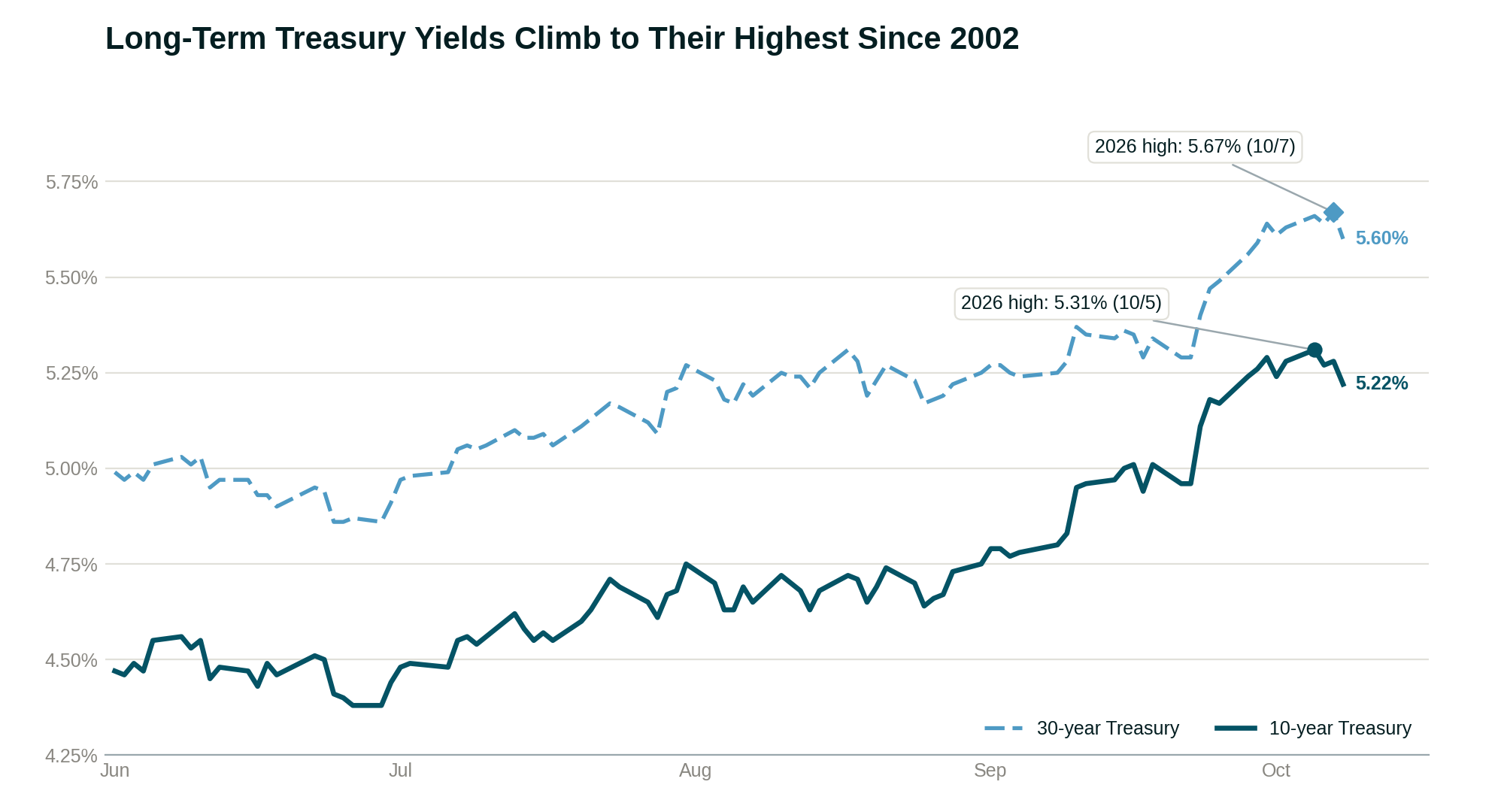
Data Source: US Department of the Treasury.
Commentary by VestGen Investment Management.
