
Oil Surge Revives Inflation and Rate Concerns
WEEKLY MARKET SUMMARY
Global Equities: The major U.S. stock indexes fell for four straight sessions before rebounding on Friday. Stocks slid from Monday through Thursday as a surge in oil prices and a hotter than expected producer price report revived inflation worries, then bounced back on Friday after crude retreated. Despite Friday’s bounce, all three major indexes finished lower on the week, with the S&P 500 down -0.8%, the Nasdaq off -0.7%, and the Dow lower by -1.6%. A sharp upward move in interest rates weighed on US small cap stocks, which slipped -2.4% during the week. Developed market international stocks fell -1.5% in the weekly session, while emerging markets ended -1.3% lower.
Fixed Income: Treasury yields pushed to multiyear highs before easing slightly on Friday. The 10-year note yield touched 4.95% on Thursday, its highest level since 2023, and stood near 4.92% on Friday as oil prices pulled back. The 30-year bond yield reached its highest since 2007, near 5.37%, while the 2-year note yield climbed above 4.5% for the first time since 2024. A hot core inflation report on Friday has investors pricing in a September interest rate increase as a near-certainty, with CME Group’s FedWatch tool showing an 87% likelihood of a hike as of Friday.
Commodities: Crude oil surged on escalating US and Iran hostilities before pulling back on Friday. Brent crude, the international benchmark, climbed above $107 per barrel on Thursday amid reports of tanker disruptions in the Persian Gulf and a sharp drop in Saudi output, while US West Texas Intermediate tested $100. Both benchmarks then eased on Friday as traders took profits. US diesel prices hit an all-time high national average of $6.05, while regular gasoline averaged $4.30 per gallon.
WEEKLY ECONOMIC SUMMARY
Consumer Prices Hold at 3.4%: The August consumer price index (CPI), released Friday and the last major inflation reading before the Fed meets, rose 0.4% for the month and held at 3.4% from a year earlier, both in line with forecasts. The gasoline index jumped 3.9% and accounted for more than one third of the monthly all-items increase, while the broader energy index rose 2.1%. Core CPI, which excludes food and energy, was hotter than anticipated at 0.3% on the month and 2.4% year over year. Despite being excluded directly from the Core CPI calculation, energy prices are impacting a wide range of goods and services, such as airline ticket prices, which rose 2.7% and are up 23.4% year-on-year.
Producer Prices Run Hot: Wholesale prices, reported Thursday, showed entrenched inflation that will likely eventually pass through to consumer prices. The producer price index (PPI) rose 0.4% in August and accelerated to 5.4% over the past 12 months, up from 4.7% in July and above expectations. Final demand goods jumped 1.1% as energy prices climbed, and processed goods for intermediate demand rose 1.8%, a sign of pipeline cost pressure building upstream before it reaches consumers. Core PPI, excluding food and energy, was softer at 0.2% for the month. The mix suggested that energy and tariff pass-through are lifting headline wholesale costs even as underlying pressure stays more contained.
Iran War Update: The conflict escalated sharply over the week, driving oil prices higher as diplomatic avenues remained closed. Iran mounted its heaviest day of attacks on merchant shipping near the Strait of Hormuz, targeting two US naval ships and eight tankers. Meanwhile, a second front opened in the south near the Bab el-Mandeb Strait on Tuesday as the Iran-aligned Houthis launched a barrage of ballistic missiles and drones against multiple Saudi cities. The strikes hit Aramco oil facilities and the King Khalid Air Base and wounded 73 civilians. The strikes ignited fires and forced a temporary halt to operations at several energy facilities in the kingdom's southern region, an area that houses the 400,000 barrel per day Jazan refinery, one of Saudi Arabia's largest. The Houthi forces were also able to capture several port cities, giving them control over Yemen’s entire western coast and potentially choking off the Bab el-Mandeb Strait, through which 10-12% of the global oil supply flows.
The Week Ahead: The Federal Open Market Committee meets Tuesday and Wednesday, September 15th and 16th, with the rate decision due Wednesday afternoon. After holding its target range at 3.50% to 3.75% for all of 2026, the Fed is now widely expected to raise rates by a quarter point, which would be its first hike of the year. The Bank of Japan’s interest rate announcement will follow on September 17th, with odds overwhelmingly anticipating a hike.
CHART OF THE DAY
The Chart of the Day shows the direct impact of energy prices on CPI inflation, which has likely forced the Federal Reserve into a September rate hike. In January and February, energy prices were a net deflationary component or relatively insignificant. The Iran war caused a massive energy shock until June, when the US-Iran Memorandum of Understanding (MOU) was announced. The MOU quickly fell apart, however, and energy prices are back on the rise as of August. While energy is a relatively small component of CPI at roughly 7.3%, the cost of transporting goods and powering electricity indirectly impacts just about every good or service in the CPI calculation. Inflation doves at the Fed will likely point to cooling Core CPI as reason for patience, but the recent escalation in Iran makes a rate hike likely with headline inflation well above the Fed’s target at 3.4%
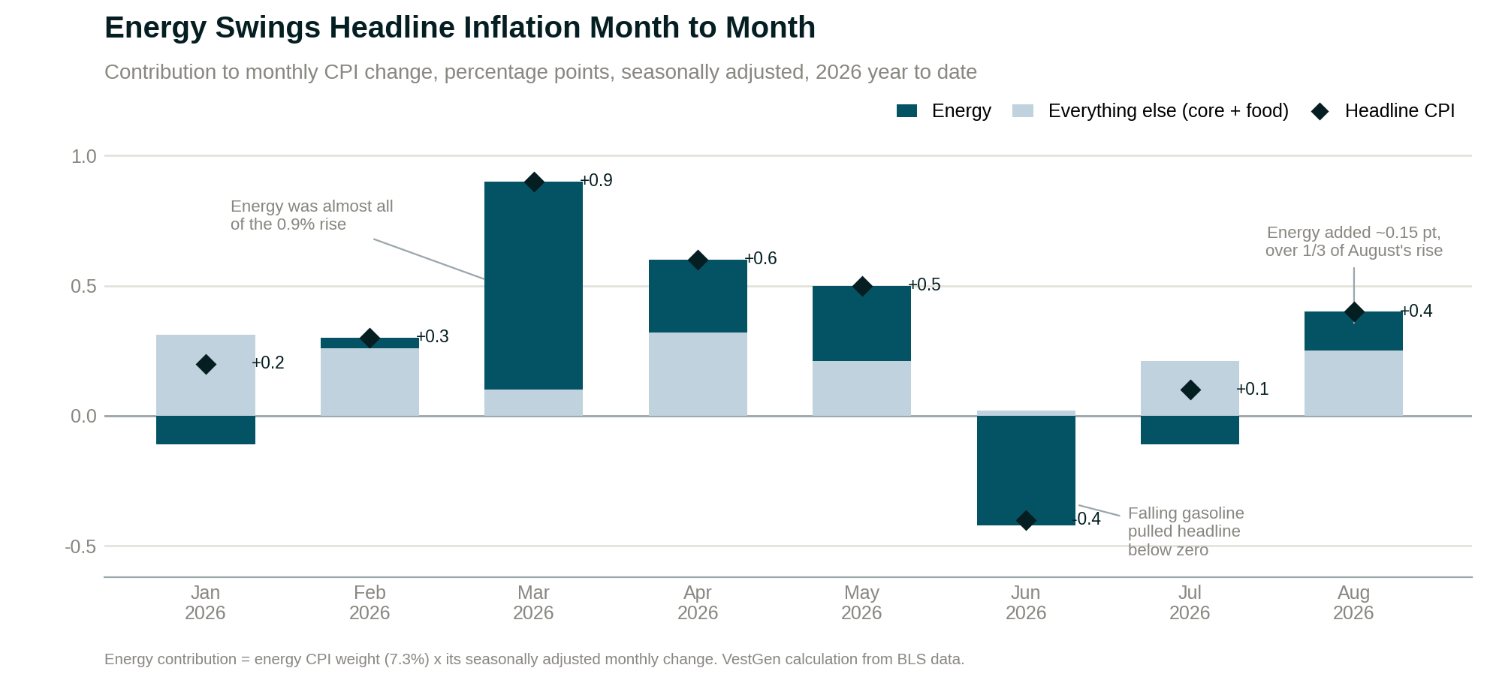
Data Source: US Bureau of Labor Statistics.
Commentary by VestGen Investment Management.