
WEEKLY MARKET SUMMARY
Global Equities: U.S. stocks managed a slight gain over the week as investors weighed a much stronger than expected August jobs report against rising global bond yields. For the week, the S&P 500 finished up 0.1% and the Nasdaq advanced 0.4%, while the Dow slipped -0.2%. Market breadth deteriorated, with the number of S&P 500 stocks trading above their 50-day moving average slipping below 50% after reaching 70% in mid-August. Small Caps ended the week up 0.2%. Foreign Developed market stocks finished 0.6% higher and Emerging Markets were the best performers for the week, ending the session up 2.3%.
Fixed Income: Treasury yields inched higher as blowout payroll numbers reinforced expectations that the Fed could raise rates at its September meeting, echoing Chair Kevin Warsh’s hawkish Jackson Hole message from the prior week. The policy-sensitive 2-year note yield ended near 3.82%, the 10-year at 4.78%, and the 30-year at 5.24%. The move tracked a sharp global repricing in long-dated debt, most visibly in Japan, where the 10-year yield pushed above 3% for the first time since 1996.
Commodities: Energy prices rose after renewed U.S. military strikes against Iran late in the prior week revived supply concerns and kept upward pressure on the near-term inflation outlook. West Texas Intermediate crude ended near $91.62, and Brent traded around $96.44 as of late Friday afternoon. Heading into the holiday weekend, U.S. diesel prices hit an all-time high of $5.85 a gallon and the US national average for gasoline has hit $4.125 per gallon, making this the most expensive Labor Day weekend on record in nominal terms.
WEEKLY ECONOMIC SUMMARY
Jobs Report Blows Past Expectations: The August employment report, released Friday, came in far stronger than expected and eased fears of a stalling labor market. Nonfarm payrolls rose by 162,000, the strongest monthly gain since March and roughly triple the consensus forecast of about 53,000. The unemployment rate held steady at 4.1%, and prior months were revised higher, with June and July together lifted by a combined 55,000. Average hourly earnings rose 0.3% on the month to $37.75 and were up 3.1% from a year earlier, while the labor force participation rate edged up to 61.6%. Leisure and hospitality, led by bars and restaurants, drove the gains, while information sector employment fell, likely reflecting continued AI-related restructuring. The report was a case of “good news is bad” for stocks, however, as a stable labor market prompted traders to raise the odds of a rate increase at the September FOMC.
ISM Surveys Show Resilient Growth and Sticky Prices: Manufacturing cooled, with the August Manufacturing PMI easing 1.0 point to 54.6%, missing expectations but registering an eighth straight month of expansion. New orders slipped 3.0 points to 53.7% even as production held firm at 58.3%. Services reaccelerated as the August Services PMI rose 1.3 points to 55.4%, a 26th consecutive month of growth. Prices stayed elevated throughout both surveys, reflecting persistent inflation. The combination of economic growth amidst pricing pressures reinforced the case for the Fed to hike rates.
Japanese Bond Yields Surge to Multi-Decade Highs: The week’s most notable move in global fixed income came from Japan, where government bond yields spiked to their highest levels in decades. The 10-year JGB yield climbed above 3% for the first time since 1996, while the 40-year yield touched a record 4.0% and the 30-year traded near its own all-time high. The selloff was driven by mounting fiscal concerns, including Prime Minister Sanae Takaichi’s proposal to cut the sales tax on food to zero, together with surging oil prices that have lifted inflation expectations. As the world’s most indebted major economy, with a debt-to-GDP ratio near 230%, rising JGB yields threaten to pull long-dated yields higher across developed markets and strain the yen-funded carry trade. The Bank of Japan will set rates the day after the Fed, on September 18th, with market pricing in around 90% likelihood of a hike.
The Week Ahead: With the labor market proving firmer than feared, attention turns to inflation. The August consumer price index (CPI), due next week, may prove to be the deciding factor ahead of the Federal Reserve’s September policy decision the following week.
CHART OF THE DAY
The Chart of the Day highlights the surge in Japanese government bond (JGB) yields, showing the path of the 10-year JGB. Fiscal expansion under Prime Minister Takaichi, a Bank of Japan edging toward further rate hikes, and oil-driven inflation have combined to lift the entire JGB curve, with the 10-year rising above 3% for the first time since 1996. Longer dated bonds are also surging, with the 40-year JGB reaching a record 4.0%. The BOJ is set to hike rates again in mid-September, which will likely push US long-term bond yields higher, regardless of what the Fed does on the short end of the curve.
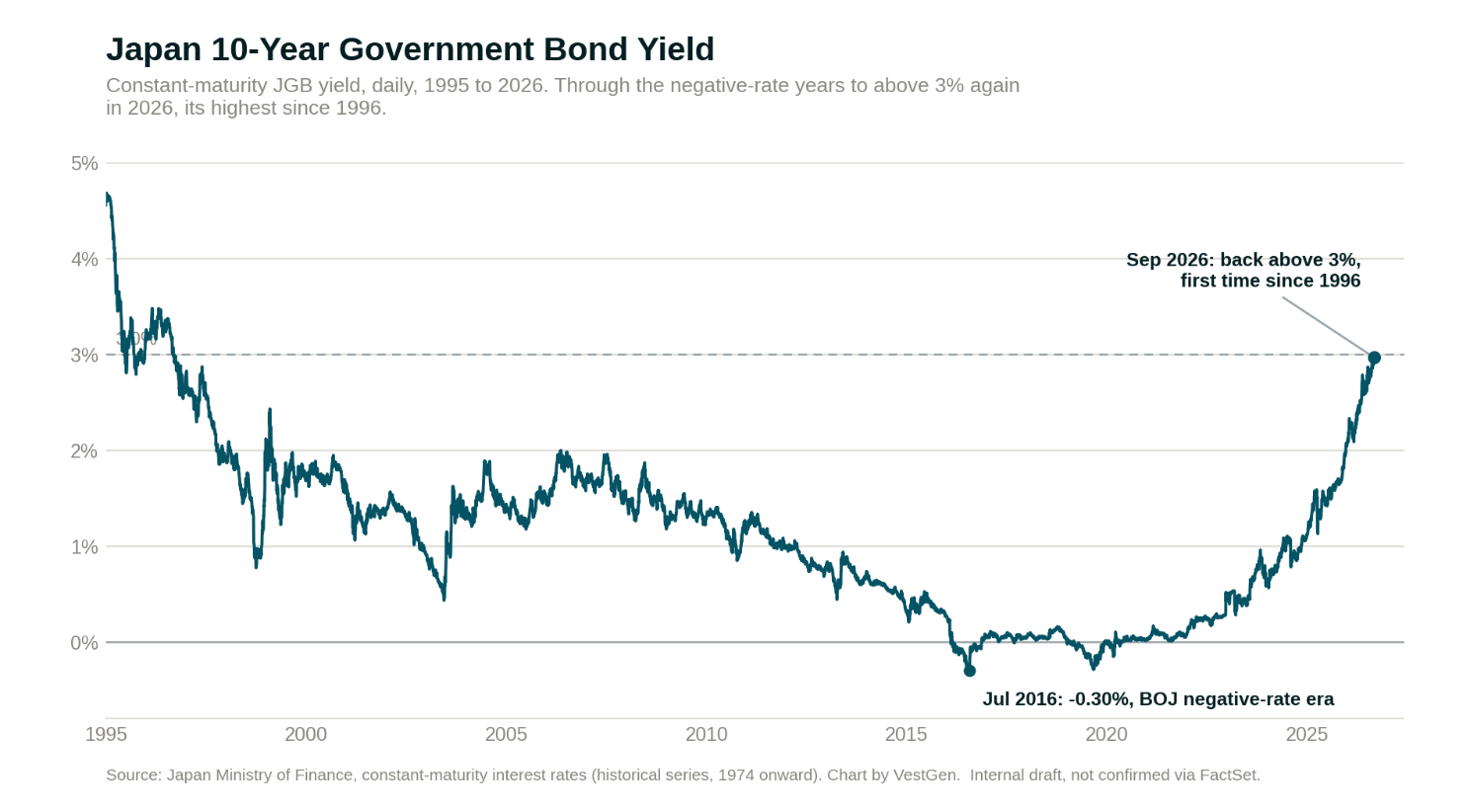
Data Source: Japan Ministry of Finance.
Commentary by VestGen Investment Management.
