
Search for "financial advisor" and you will find dozens of titles: wealth manager, planner, broker, investment adviser, retirement specialist. The many types of financial advisors can make it hard to know who does what, how they are paid, and which rules they follow.
This guide sorts the most common types of financial advisors into simple groups. It explains what each one typically does, how they are regulated, and what questions can help you decide which kind of professional fits your situation.
Why There Are So Many Types of Financial Advisors
"Financial advisor" is a general term. It is not a single license or credential. Many different professionals use it, and the term alone does not tell you what services you will receive or what standard of conduct applies.
That is why people search for things like "different kinds of financial advisors" and "what kind of financial advisor do I need." The better question is often: what do I need help with, and who is set up to provide it?
Three ways to sort advisors
A simple way to compare advisors is to look at three things:
Registration: How the professional or firm is registered with regulators.
Services: Whether the focus is investments, planning, insurance, or a mix.
Compensation: Whether the professional is paid through fees, commissions, or both.
Registered Investment Advisers (RIAs)
A registered investment adviser is a firm that provides advice about securities for compensation and is registered with the SEC or state securities regulators. Individuals who work for these firms are often called investment adviser representatives.
How RIAs typically work
Ongoing advice: Many RIAs offer ongoing investment management and planning within an advisory relationship.
Fee-based pay: RIAs commonly charge asset-based fees, flat fees, or hourly fees.
Fiduciary duty: RIAs generally owe a fiduciary duty to their advisory clients.
Disclosures: RIAs file Form ADV, which includes a brochure describing services, fees, and conflicts of interest.
For a deeper look at the standard RIAs follow, see our article on what a fiduciary financial advisor is.
Brokers and Registered Representatives
Brokers, often called registered representatives, work for broker-dealers. They can buy and sell securities for customers and may recommend investments.
How brokers typically work
Transaction focus: Brokers are often paid through commissions tied to transactions or products.
Regulation Best Interest: When recommending securities to retail customers, broker-dealers are generally required to act in the customer's best interest under the SEC's Regulation Best Interest.
Registration checks: You can review a broker's registration and history through FINRA BrokerCheck.
Dual registration
Some professionals are registered both as investment adviser representatives and as registered representatives of a broker-dealer. The rules that apply may depend on the account and the service, so it is worth asking which role the professional is acting in for each recommendation.
Financial Planners
A financial planner focuses on building a plan for your overall financial life. That may include retirement, cash flow, taxes, education, insurance, and estate considerations.
What financial planners may help with
Goal setting: Clarifying what you want your money to do, and when.
Retirement projections: Estimating whether savings and income may support your retirement.
Coordination: Looking at how investments, taxes, insurance, and estate plans fit together.
"Financial planner vs financial advisor" is a common search. In practice, a planner describes the type of work. A financial planner may also be an investment adviser representative, a broker, or both.
Other Types of Financial Professionals
You may also come across professionals who focus on one area:
Insurance agents: Licensed to sell insurance products such as life, disability, or long-term care coverage.
Retirement plan advisors: Help employers with workplace retirement plans like 401(k) plans.
Wealth managers: Often provide a combination of investment management, planning, and coordination with tax and legal professionals.
Credentials and designations can add context, but they vary widely in requirements. You can look up what a designation requires before giving it weight.
RIA vs Broker vs Planner: A Quick Comparison
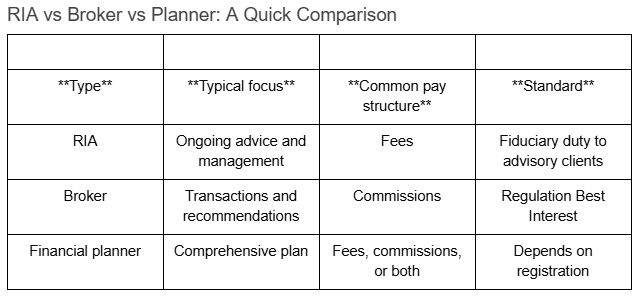
This table is a simplified overview. Individual arrangements can differ, so review each firm's disclosures.
Which Type of Financial Advisor Do You Need?
The right fit often depends on how complex your situation is and how much ongoing help you want.
Just starting out? You may want planning help with saving, budgeting, and goals.
Approaching retirement? Consider an advisor who can help with income planning, Social Security timing, and tax considerations.
Business owner or family with complex needs? A coordinated approach covering investments, tax, and estate considerations may be helpful.
At VestGen, our advisors offer a comprehensive suite of services designed to meet your needs at every stage of life, including Comprehensive Planning, Retirement Income Planning, Investment Management, Estate Planning, Tax Optimization, Insurance Solutions, and Education Planning. You can learn more on our Services page. For more background, read our earlier guide to understanding different types of financial advisors.
Who VestGen Serves and Where
Every financial journey is distinct, and so is our approach. VestGen Wealth Partners offers bespoke wealth management solutions crafted to align with your individual goals and aspirations.
VestGen serves clients across the nation through many office locations, offering both a local presence and the strength of a broader advisory team. Offices include Chicago, Glen Ellyn, Schaumburg, Naperville, Oak Brook, South Barrington, St. Charles, and Downers Grove in Illinois, as well as Kirkwood and Kansas City in Missouri, and locations in Texas, New Jersey, Florida, and North Carolina. You can find an advisor near you or learn more about why VestGen.
Ready to Start Your Journey?
Knowing the types of financial advisors can help you ask clearer questions. If you would like to talk through your goals, contact VestGen Wealth Partners to schedule a consultation with one of our advisors. Together, we can chart a course toward your financial future.
Frequently Asked Questions
What are the main types of financial advisors?
Common types include registered investment advisers, brokers or registered representatives, financial planners, insurance agents, and retirement plan advisors. Many professionals combine more than one role.
What is the difference between an RIA and a broker?
An RIA generally provides advice for a fee and owes a fiduciary duty to advisory clients. A broker generally earns commissions on transactions and follows Regulation Best Interest when making recommendations to retail customers.
Is a financial planner the same as a financial advisor?
Not exactly. "Financial advisor" is a broad term. A financial planner focuses on building a comprehensive plan, and may also be registered as an investment adviser representative, a broker, or both.
Which type of financial advisor is best for retirement?
It depends on your needs. Many people preparing for retirement look for help with income planning, investment management, and tax considerations, and ask how the advisor is paid and which standard applies.
How do I check what type of advisor someone is?
Review the firm's Form CRS and Form ADV, and search the SEC's Investment Adviser Public Disclosure site or FINRA BrokerCheck to see how the professional is registered.
Do all types of financial advisors charge fees?
No. Some charge asset-based, flat, or hourly fees, some earn commissions, and some receive both. Ask for a clear explanation of all compensation.
This article is for informational and educational purposes only and does not constitute financial, legal, or tax advice. Advisory products and services offered through VestGen Advisors, LLC, a Registered Investment Advisor. Securities offered by Registered Representatives through Private Client Services, Member FINRA/SIPC. Private Client Services and VestGen Advisors, LLC are unaffiliated entities. VestGen Advisors and Private Client Services do not offer legal or tax advice, and information here should not be construed as such. Always consult a legal or tax professional regarding your specific situation. VestGen financial advisors may only conduct business with residents of the states and/or jurisdictions for which they are properly registered. Not all of the investments and services mentioned herein are available in every state. All investing involves risk, including the possible loss of principal. Past performance is not a guarantee of future results, and no strategy can guarantee a particular outcome. Please review VestGen's Form CRS and Form ADV Part 2A for more information.